
Serbia
Alta Banka's operating license revokedDavor Macura's bank collapsed, four vice presidents of the central bank turned to the prosecutor's office
Davor Macura went from a money changer in Zimony to state contracts and regional acquisitions. Alta Banka, which was previously subsidized by the state, lost its operating license; the story also includes a 12 million euro loan, real estate deals in Belgrade and EXPO subsidies, and many players from Vučić's hemisphere


Five days after the Serbian elections, the benga hit the business world associated with the Serbian Progressive Party (SNS), one of whose most spectacular success stories was produced by Alta Banka.
The National Bank of Serbia has revoked the bank's operating license, and the four vice presidents of the central bank want the prosecutor's office to find out who in their own institution knew about the true state of the financial institution and when.
The main character of the story is Davor Macura, who started out as a money changer in Zimony and built a billion-dollar business empire. His clients were mainly state-owned companies, and he had money for real estate in Belgrade, hotels, and recently for the acquisition of the Serbian chain of stores of the Croatian company Fortenova.
The Serbian "financial dream" was going well until the climate changed after the elections.
Alta Banka has been described by the Serbian press for years as a financial institution favored by Vučić's power circle. According to BIRN's investigation, Macura's businesses had business ties with Nikola Petrović, Vučić's confidant, as well as with Milan Radoičić, the perpetrator of the Banjska attack, and the family of the equally dubious Zvonko Veselinović.
He was locked up on Friday, his license was revoked on Saturday.
On October 30, Alta Banka's account was frozen, and on October 31, the National Bank of Serbia (Narodna banka Srbije, NBS) officially announced the revocation of the financial institution's operating license.
The central bank's statement revealed that Alta Banka had previously been inspected and ordered to improve its liquidity. However, the bank's financial situation continued to deteriorate, putting depositors' money at risk.
There were problems with the cash flow even before the lockdown. According to Vreme, Alta Pay instructed its business partners to make their payments not at Alta Banka, but at the Postal Savings Bank (Poštanska štedionica) or OTP.
The bank later suspended card transactions, domestic and foreign currency payments, and closed its branches.
Macura, who the Serbian press had considered for years among the businessmen close to the Progressives, was left without a bank a few days after the party's election defeat.
Four vice presidents of the central bank turned to the prosecutor's office
Following the closure of Alta Banka, four vice presidents of the National Bank of Serbia – Željko Jović, Ana Ivković, Dragana Stanić and Nikola Dragašević – jointly turned to the prosecutor's office.
They asked him to investigate whether there had been any criminal negligence within the central bank.

Related article
According to a statement published by Radar, the vice presidents were only confronted with Alta Banka's actual financial situation at an extraordinary board meeting convened on the evening of October 30. The conditions were drastically different from what the bank had previously reported to the supervisory authority.
The four vice presidents of the central bank are therefore claiming that one of the country's financial institutions has collapsed, something they only learned about at the last minute.
The vice presidents are demanding that it be revealed when and at which management level the risks were recognized, how professional warnings were handled, and why appropriate measures were not taken in a timely manner.
The questions also concern the environment of the central bank governor, Jorgovanka Tabaković. The NBS said that proceedings have been initiated against the bank, its shareholders and managers, as well as other responsible persons.
Twelve million euros in loans, barely nineteen thousand euros in income
Two days before the bank closed, Radar uncovered a remarkable loan deal. Alta Banka provided a 12 million euro loan to the company Loga Plus, owned by businessman Vladan Miketić.
Miketić is being prosecuted for attempted murder and incitement, and the indictment links Miketić to the criminal group known as "Vračarci".
Loga Plus' financial performance hardly justified the generous loan. The data examined by Radar shows annual sales of only 18,700 euros, and the company had been loss-making in previous years.

The 12 million loan was nearly 138 times the company's total four-year revenue. With the money, Miketić's company purchased part of the Albania Palace in Belgrade: seven floors of retail space, additional rooms and restrooms, a total of 3324 square meters. The purchase price was approximately 13 million euros.
The loan agreement was concluded on November 27, 2025, but the mortgage was only registered in August 2026.
The financial background of the purchase of the property was already being investigated by the organized crime prosecutor's office. On May 26 of this year, the police requested data from the financial investigation unit, but according to a report by Radar at the end of October, they did not receive a response for five months.
According to bankers interviewed by the newspaper, most banks would not even consider a loan application from a company with such financial indicators. Moreover, the real estate used as collateral is under investigation by the prosecutor's office.
The loan was for 24 months, with a lump sum repayment. If Loga Plus cannot repay its debt, the property serving as collateral may be seized by the lender. Alta Banka and Loga Plus did not respond to Radar's questions.
There was already a Hotel Union in front of the Albania Palace
However, Miketić and Macura's business relationship did not begin with this, as Loga Plus purchased the Hotel Union in Belgrade for 6,2 million euros in June 2024.
A year and a half later, in December 2025, the property was already owned by a company called Procoopac, owned by the Alta Group and Relja Štrbac, who travels in the trade of pharmaceuticals and medical devices.
And what the hell, the Serbian Ministry of Economy approved three million euros in state aid for the renovation of the hotel as part of the preparations for EXPO 2027.
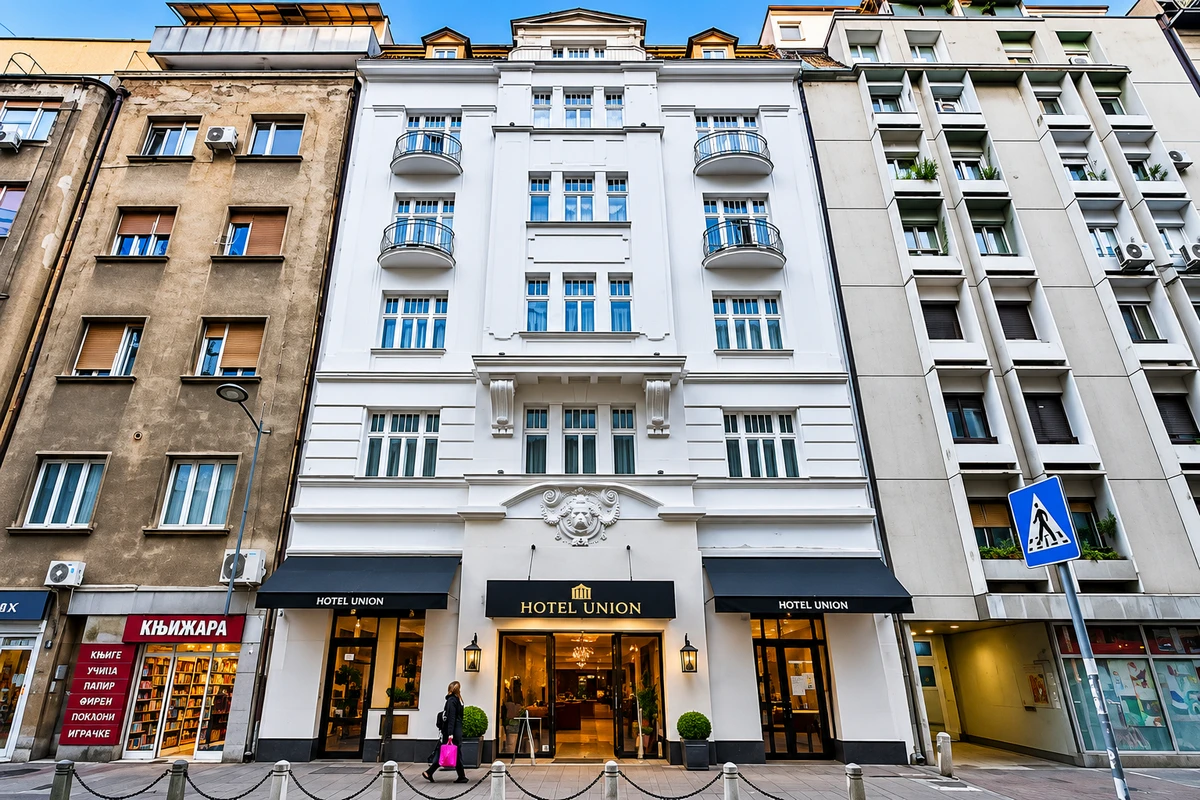
Hotel Union in the inner city of the Serbian capital (Source: Google)
According to Radar's investigation, based on documents, the support was received by Macura's company, even though it was not yet registered as the owner of the hotel at the time of the contract.
The company had to commit at least 15 million euros to the renovation. The grant application was submitted on November 29, 2024, supplemented on December 11, and signed nine days later.
According to Radar, the work was carried out without a building permit. The state nevertheless paid out 1,88 million euros by April 2026, with the remaining 1,12 million planned for the end of the year.
The two businessmen are also connected by sport: both hold positions in the Serbian Boxing Federation. Macura is the chairman of the board of directors, Miketić is the vice president of the supervisory board.
From the money changer in Zimony to the state-supported banker
Davor Macura began his business career with a money changer in Zimony in 2008. He later built money changers, cash handling and gold trading businesses, and then gradually acquired Jumbes Banka, the predecessor of Alta Banka, from 2019.
The financial institution soon boasted clients that other banks could only dream of: the electricity provider Elektroprivreda Srbije (EPS), the Serbian Automobile and Motorcycle Association, and part of the cash flow of the Belgrade parking company were also organized around Alta.

According to Serbian internet folk, Davor Macura, the owner of Alta Bank, left Serbia two days before the operating license of the financial institution he runs was revoked (Source: X platform)
Instead of the state-owned Poštanska štedionica, a relatively small private bank has been awarded significant public utility deals. According to former central bank governor Dejan Šoškić, such opaque state-private bank agreements can create privileged positions and distort market competition.
Šoškić was the president of the National Bank of Serbia between 2010 and 2012, is currently a professor at the Faculty of Economics in Belgrade, and ran in 27th place on the winning University List. On October 28, he was asked if he would be the new prime minister, to which he replied that he could not say for now.
One of Macura's companies, ABL Solvent, purchased the former IMT tractor factory in New Belgrade for around 70 million euros in 2021, where a luxury residential area is planned. In many cases, real estate development is a playground for the mafia.
According to Vreme, the investor later acquired the 33-hectare area, previously owned only with the right of use, as property for free, and the state supported the project with infrastructure developments.
According to Radar's calculations, the Alta Pay group generated more than 85 million euros in net profit over five years, of which 30,7 million in 2025. Not a bad result for a business that started with a money exchange.
The Croatian Fortenova has also joined the empire
Macura's business plans have long gone beyond Serbia's borders. Alta Retail officially took over the Serbian retail interests of the Croatian Fortenova group in October 2026.
The deal focused on Idea Marketi, which operates stores under the Idea, Mercator and Roda brands in more than eighty municipalities in Serbia.

With the purchase, four additional companies were added to Alta Retail: food supplier Enna Fruit Grocka, the company operating the Super kartica loyalty program, real estate company M-Profil SPV, and IT services provider mStart Business Solutions.
The closing of the deal was also announced by Fortenova. Due to the collapse of the bank, the aforementioned retail chains may face financing problems.
Macura had also been eyeing other banks before the collapse. Alta Group was preparing to acquire Addiko Bank's interests in Serbia, Montenegro and Bosnia and Herzegovina. According to Radar, with the demise of Alta Banka, this regional expansion will naturally fail.
Alta already had financial interests in North Macedonia, and new unpleasant questions arose.
Andrej Žernovski, a politician from the Macedonian opposition SDSM, demanded an explanation from the government and central bank in Skopje regarding reports that Serbian money may have been sent abroad, including to Russia, through Macedonia.
The Serbian central bank, however, denied allegations of money laundering abroad related to Alta Banka.
Macura gained world fame
The owner of Alta Banka also became popular in Washington before the revocation of its operating license, as he was included in a sanctions proposal by a US congressman.
Republican politician Joe Wilson wrote to US Secretary of State Marco Rubio on October 14, requesting sanctions against four Serbian businessmen.
The letter, which was published by Radio Free Europe, included Davor Macura, Željko Mitrović, the owner of Pink Television, and Ivan Bošnjak and Stojan Vujko, the two owners of Millennium Team.
According to Wilson, those involved were connected to Aleksandar Vučić's power circle and used public resources for their personal enrichment.
The congressman requested that they be banned from entering the United States and from using the American financial system.
People were standing in line in Novi Sad
On Saturday, customers gathered in front of the Alta Banka branch on Felszabadulás Avenue in Novi Sad. Footage circulating on social media shows a long line at the bank branch on the avenue leading to the train station, next to the building of the very pro-government Dnevik newspaper.
People wanted to access their money, but accounts were generally closed and credit card transactions and transfers had already been suspended.

On Saturday, a significant queue formed in front of the Novi Sad branch of Alta Banka (Source: X platform: Kreni-promeni )
The National Bank of Serbia announced that the Deposit Insurance Agency will take over the supervision of Alta Banka's assets, which may act as a liquidator in the bankruptcy proceedings.
In Serbia, the upper limit of deposit insurance per depositor and per bank is 50 thousand euros. Claims exceeding this amount must be enforced in bankruptcy proceedings.
Alta Banka indicated to N1 that the payment of insured deposits could begin as early as Monday.
According to official information from the Deposit Insurance Agency, payments must begin no later than seven working days after the court order to initiate bankruptcy proceedings. Information on the places and conditions of payments will be provided within three working days.
Borrowers, however, are not doing well with the bank's bankruptcy because they are not free from their debts: they will still have to repay after Alta Banka closes, and the further payment schedule will be determined in the bankruptcy proceedings.
BALK Games
Choose a game and play right here on BALK!
Loading games…
The games are provided by GamePix. When you start the game, the content from the third-party provider is loaded.


VUČIĆ IS BACK: 103 minutes of speech, yogurt incident and VMSZ plan

They defeated Vučić, but can Serbian students govern?

A Serbian MiG-29 crashed near Ópazová: the pilot died

Serbian Parliament: What awaits Serbia after November 17?

Croatia's defense spending could exceed 2 billion euros next year

Vučić's Kosovo crisis general retires

Hereditary Republic: Will Igor Dodik be the Prime Minister?

Kurti would immediately make Serbian students answer: Recognition of Kosovo is the first lessonKurti is singing his own tune, already demanding recognition of Kosovo, which the winning University List had previously rejected

We ask for a beautiful smile! (but it can also be tearful) 🔞The grotesque world of the Kharkiv photography school, taboo-breaking artists and war images – also in Kragujevac

God's mills grind slowly: After 35 years, the first compensation was awarded to a victim of Serbian concentration campsSerbian prison camps: must pay after 35 years, Belgrade fears for state coffers

Serbia gets away with Kushner deal without punishmentTrump's son-in-law will not have a luxury hotel in Belgrade, and the Serbian state can avoid a 50 million euro compensation claim

Pásztor would bury the hatchet, Fremond would have coffee, Góli is looking for his hatThe campaigns are over, the VMSZ senior leadership does not want to see enemies, but cooperation with the Tündi-Bündi opposition

Fake 500 euro notes in the vault(?), real Russian depositors in pickleIt is not yet certain that there were any fake 500 euro notes, but it is certain that thousands of Russian depositors got into trouble.

Vučić's concrete empire is cracking: arrest warrant issued against the owners of Millennium TeamThe police were delayed, and the lawyers were requesting an exclusion, so the authorities were unable to arrest the leaders of the Millenium Team


Sputnik: Hungary may pay dearly for giving up Russian energyMoscow is warning of price increases, and according to Sputnik, the Hungarian economy could also be affected.
The price of giving up Russian energy is already being calculated in Belgrade and Moscow. According to Sputnik Serbia, Hungary will face more expensive gas, uncertain oil supplies and...


Balázs Orbán defends Informer: he sees "authoritarian liberals" already in BelgradeBalázs Orbán defends Informer while Serbian media authority investigates channel's behavior
The Hungarian-Serbian political friendship persists even after the election defeats, and has now extended to saving Informer TV. Orbán...


THE BATTLE OF THE LOSERS: Vučić, Dodik and Pásztor friendship with OrbánAfter Orbán's visit to Belgrade, Vučić would once again take up the SNS presidency in a "sign of renewal"
Voters have rewritten the political map, but Viktor Orbán is still working from the old address list. On his Balkan tour, Milorad Dodik, Pásztor...


We ask for a beautiful smile! (but it can also be tearful) 🔞The grotesque world of the Kharkiv photography school, taboo-breaking artists and war images – also in Kragujevac
Ukrainian photography is not known for always showing the world as beautiful. From the grotesque images of the Kharkiv School to the fringes of society...


After the Moments of Fall (drama, with a happy-sad twist)Vučić announced defeat, then sang Rosemary. Arthur Miller's drama provides the encore and the impact
Aleksandar Vučić and the Serbian Progressive Party had a strange evening after the Serbian elections. The announcement of the defeat was met with stunned silence, then...


Books have their own problems too.The 69th Belgrade Book Fair has opened, but will soon close, and will be open for a week.
The 69th Belgrade Book Fair is still waiting for readers despite the boycott by several major Serbian publishers. This year's guest of honor is Tunisia, the...

VUČIĆ IS BACK: 103 minutes of speech, yogurt incident and VMSZ planThe Serbian parliament has been formed, and it seems that it may have a Hungarian vice president, but not from the ranks of the deposed VMSZ
The Serbian parliament has convened in a new composition, but Aleksandar Vučić is apparently not prepared to play the role of silent opposition. The former head of state immediately...

They defeated Vučić, but can Serbian students govern?Students want to end the close defense cooperation with Israel established during the Vučić era
Serbia's student movement has won a historic election victory, but governance presents it with new challenges. The New York Times, November...

Croatia's defense spending could exceed 2 billion euros next yearCroatian army receives record amount of money, but missile defense development is hampered by political obstacles
The Croatian army will be able to manage with more money than ever before in 2027, but one of the most important elements of the armament plans, modern missile defense, will still be...


JANAF has a little hole, the Hungarian and Croatian Speakers met in BratislavaDamage to JANAF's oil pipeline resulted in the release of 500 cubic meters, or half a million liters, of oil into the environment.
The damage to the JANAF oil pipeline in Croatia resulted in half a million liters of oil being released into the news, which at first glance sounds quite alarming. In cubic meters, this is only...

Hereditary Republic: Will Igor Dodik be the Prime Minister?Milorad Dodik can now prepare the position of Prime Minister for his son
Milorad Dodik's son is a candidate for the post of Prime Minister of the Republika Srpska in Bosnia, but others in the SNSD also claim the position,...


Croat-Bosnian (v)horrors: endless games in MostarMostar remains divided, conflict follows conflict 33 years after the destruction of Stari Most
Stari Most has been reconnecting the two banks of Mostar for more than twenty years, but the gap between the two communities continues to...


Đukanović to Belgrade: Will Serbia have a government, or will the Serbs of the region?Former Montenegrin President Milo Đukanović urges Serbian political change in Cetinje, while Lajčák also returns
Twenty years after Montenegro's independence was restored, Milo Đukanović once again appeared in public in Cetinje to take stock of the country's past...


Proceedings against Montenegro over Pljevlja remain openSeventy million euros have already been spent, but the case has not been resolved, and the Pljevlja coal-fired power plant is a stumbling block on Montenegro's path to the EU.
Montenegro is already on the threshold of the European Union, but the chimney of the coal-fired power plant in Pljevlja continues to send smoke signals to Brussels. The seventy million euro...

Vučić's Kosovo crisis general retiresThe retired chief of staff was a key figure in the Kosovo crises and Vučić's military policy
It was necessary to flex our muscles towards Kosovo and negotiate sensibly with KFOR: Milan Mojsilović spent eight years trying to reconcile military realities with Aleksandar...

Kurti would immediately make Serbian students answer: Recognition of Kosovo is the first lessonKurti is singing his own tune, already demanding recognition of Kosovo, which the winning University List had previously rejected
Serbian university students haven't even formed a government yet, and Albin Kurti would already be making them answer questions. Recognition of Kosovo would be the first exam question, Milan Radoičić...


Fico would dismantle Slovakia's Western federal systemFico attacks the 2003 Slovak EU referendum without evidence, also opens a debate about NATO
Robert Fico would rewrite Slovakia's European history: he believes the results of the 2003 EU referendum were falsified, even though he himself voted for accession at the time...


The Hungarian Alliance in Slovakia is preparing for parliament, but was even pushed back in the local electionsThe Hungarian Alliance lost 326 seats, but is still preparing for parliament
In Slovakia, everyone declared themselves the winner after the local elections – at least according to the statements of the parties. However, in the case of the Hungarian Alliance, the...


The government trembled in Fico's handsAfter Taraba's fall, it was not just a ministerial position that was at risk, but Robert Fico's parliamentary majority.
After thirty-three years, the Slovak parliament has once again ousted a minister, but the departure of Tomáš Taraba is only the spectacular part of what is a serious...


Defense money: Romania would buy American soldiersBucharest is ready to pay the "transatlantic tribute", as long as the American soldiers stay
Allied loyalty has been raised to a new level in Bucharest: Romania would now not only host American soldiers, but would also pay for them to...


Full power government with a six-month warranty periodPSD received ministerial posts, PNL and RMDSZ support from outside: Luca Niculescu's government was voted in
The Romanian parliament voted for the government of Luca Niculescu, but no one gave a guarantee of political peace. The PSD won twelve ministerial seats...
