
Romania
Romanian president rules out early electionsThe Mureșan government has fallen, but the president would not allow early elections in Romania just yet
In Romania, early elections should be held according to the letter of the constitution, but the head of state prefers to read between the lines. Siegfried Mureșan's government fell short of the required majority by 51 votes, so the third attempt to form a government has now run aground. Nicușor Dan would give the parties another chance, but the PSD is already winking at the AUR. And if this ever becomes a government, it will be golden


Another attempt to form a Romanian government set a record low in the legislature on Wednesday. The Mureșan government received only 182 votes in favor, failing to take office. Siegfried Mureșan is the third prime minister candidate to fail in a parliamentary vote since May 5: he needed 233 votes to be elected, but fell short by 51.
Previously, neither Eugen Tomac nor Adrian Veștea had managed to get the government they proposed approved by the fathers-in-law. Tomac withdrew his mandate, while Vestea and Mureșan appeared before the legislature and were rejected.
The letter of the constitution
Romania's constitution stipulates that if neither of the two prime ministerial candidates succeeds in forming a government, the president has the right to call early elections. In the 37-year history of modern Romania, the possibility of dissolving the legislature has never been raised.
The Mureșan government's attempted inauguration has also aroused great interest in Western European chancelleries. The authoritative Politico sees Romania's current situation as follows:
“Romania – a key strategic ally of NATO that has felt the effects of Russia’s war against Ukraine – has barely been able to prevent the far-right from seizing power in the series of parliamentary and presidential elections that began in the winter of 2024.”

This would have been the task of Siegfried Mureșan, this was what President Nicușor Dan expected, the European party alliance PNL-USR-RMDSZ - minus the PSD - the presidency of the European Parliament, the European People's Party, of which Mureșan is also vice-president.
“Another defeat in Bucharest would pave the way for early elections that would deepen divisions in the EU’s seventh most populous country, where the far-right is leading in opinion polls, at a moment when nationalist-populist parties are gaining ground across Europe,” the newspaper wrote.
The alarm had no effect.
What could Mureșan have hoped for? Only that the threat of early elections would force the deputies to vote for the Mureșan government despite their party's previously announced intention.
After the prime minister-candidate ruled out cooperation with the eurosceptic AUR - in which case he would have lost the support of the RMDSZ - he stated that he expects PSD members to vote "according to their conscience".
He referred to the personal interests of the fathers-in-law when he said that “the members of parliament will know that it will either be this government or early elections. I would not want to be a PSD member and find out on TV that the parliament is being dissolved, so I would probably no longer be a member of parliament, or I would be a member of a small party that barely passed the 5% threshold.”
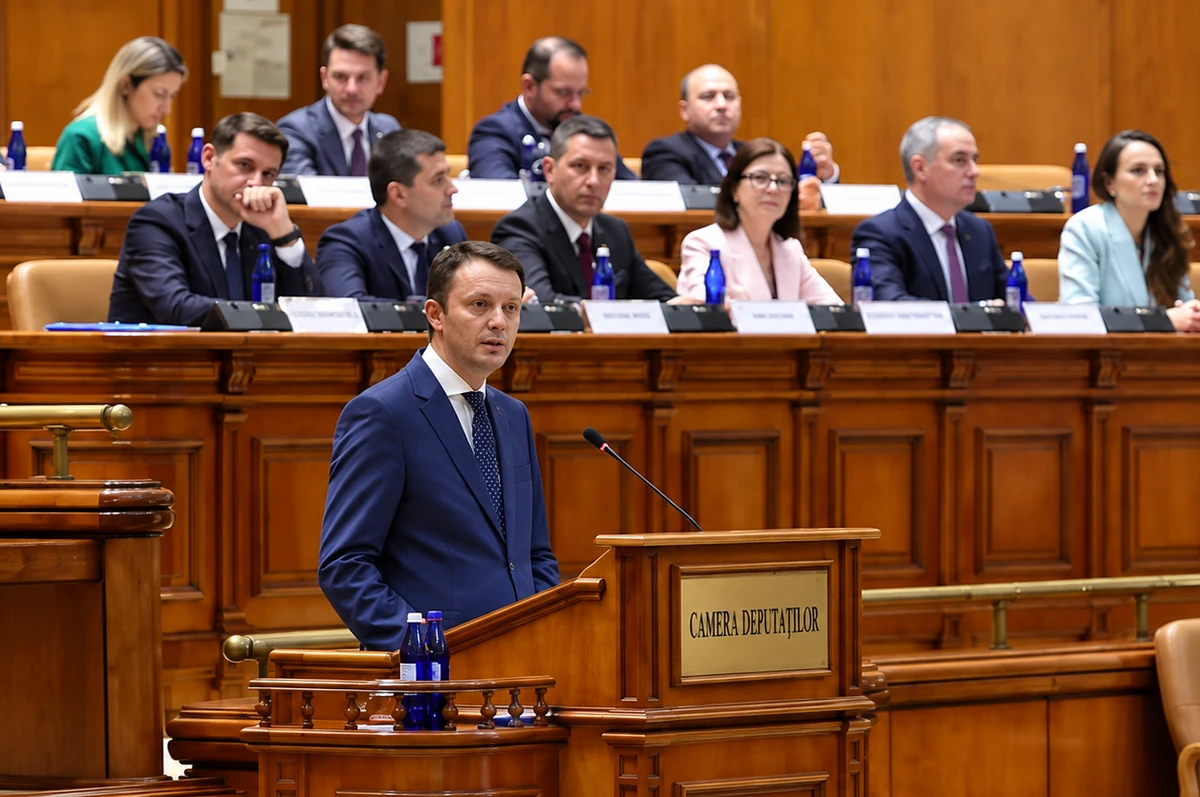
197 senators and representatives cast their votes. According to an announcement made from the parliament's rostrum, it was determined that the necessary majority was not achieved, so the government led by Siegfried Mureşan could not be inaugurated (Source: RFI )
He warned of the PSD's loss of image and even European identity. In addition to the warning, he also mentioned the previous good cooperation with the PSD:
“In the European Parliament, the Social Democrats stood by me on every law.”
For the PSD, tomorrow's vote will be a "test" to see whether it is a pro-European party or an unprecedented political formation in the EU, as nowhere else is there cooperation between European social democrats and right-wing extremists.
Mureșan tried to mask the lack of a parliamentary majority that could not be negotiated as the PSD's responsibility.
In an interview with Politico, he claimed that the PSD had reached a "moment of truth" after PSD President Sorin Grindeanu announced that the party would not vote for the Mureșan government and did not rule out a coalition with AUR, "a far-right party that sought confrontation with Brussels and supported pro-Russian candidates."
Mureșan tried to exploit his position in Brussels – which he had built up over many years in European decision-making circles – to play a winning card in Bucharest.

The leaders of the centre-left S&D European group in Brussels are “clearly responsible for the activities of their member parties” and “face a very serious credibility problem if they continue to remain silent about the close cooperation between their Romanian member party and the far right,” he said.
"Until European socialists take credible steps to prevent this, unfortunately we cannot rule out that socialists in other countries will also follow this path," Mureșan warned.
At the end of his statement, he also pointed out the danger that if the far-right came to power, "Romania would have a government that is very friendly to Russia, which would be to the detriment of Romanian citizens and the European Union."
Until yesterday, the question was whether the threat would have an effect on PSD representatives, and whether EU negotiators had enough influence on Romanian domestic politics to get the Mureșan government through the eye of a needle? Today we know the answer: No, it doesn't.
The spirit of the constitution
President Nicușor Dan, who is visiting the Czech Republic, announced at a late-night press conference on Monday that anyone who reads from the constitution that early elections will be called is wrong. (The PNL and USR are demanding early elections, as is the likely sole winner of the elections, the AUR.)
The head of state stated that Romania lives on loans, while credit rating agencies indicated that the worst-case scenario for Romania would be early elections.
So the president is making one more attempt, calling on the members of the European alliance, above all the PSD and PNL, which have become mortal enemies from coalition partners, to agree on a common prime ministerial candidate by Monday, to continue governing and isolate the extremist, anti-European, populist AUR.
If so, will it be cute?
The PSD continues to show no willingness to cooperate with the PNL. According to Ionuț Pucheanu, PSD First Vice President, there are several options for the PSD to form a stable government, including cooperation with the AUR as a last resort.
According to Pucheanu, the previous alliance with USR surprised PSD voters, but “our voters have no problem with AUR.” (Aur means gold.) The first vice president is confident that the next government will be installed if it has a social democrat prime minister.
Maybe this government will become “cute”?
BALK Games
Choose a game and play right here on BALK!
Loading games…
The games are provided by GamePix. When you start the game, the content from the third-party provider is loaded.


Will Hungarians ever allow the Chinese high-speed rail?

Serbia gets away with Kushner deal without punishment

JANAF has a little hole, the Hungarian and Croatian Speakers met in Bratislava

The cronies are fleeing: after Veselinović, Radoičić has reportedly also resigned

Compulsory conscription: the University Student List wants volunteers, not conscripts

We ask for a beautiful smile! (but it can also be tearful) 🔞

God's mills grind slowly: After 35 years, the first compensation was awarded to a victim of Serbian concentration camps

Kurti would immediately make Serbian students answer: Recognition of Kosovo is the first lessonKurti is singing his own tune, already demanding recognition of Kosovo, which the winning University List had previously rejected

Croat-Bosnian (v)horrors: endless games in MostarMostar remains divided, conflict follows conflict 33 years after the destruction of Stari Most

Vučić is only a witness in the Šarić case for now - will he become a defendant?A drug lord's money laundering trial, did money from drug trafficking go to the Serbian Progressive Party?
God's mills grind slowly: After 35 years, the first compensation was awarded to a victim of Serbian concentration campsSerbian prison camps: must pay after 35 years, Belgrade fears for state coffers

Pásztor would bury the hatchet, Fremond would have coffee, Góli is looking for his hatThe campaigns are over, the VMSZ senior leadership does not want to see enemies, but cooperation with the Tündi-Bündi opposition

Fake 500 euro notes in the vault(?), real Russian depositors in pickleIt is not yet certain that there were any fake 500 euro notes, but it is certain that thousands of Russian depositors got into trouble.

Defense money: Romania would buy American soldiersBucharest is ready to pay the "transatlantic tribute", as long as the American soldiers stay


Sputnik: Hungary may pay dearly for giving up Russian energyMoscow is warning of price increases, and according to Sputnik, the Hungarian economy could also be affected.
The price of giving up Russian energy is already being calculated in Belgrade and Moscow. According to Sputnik Serbia, Hungary will face more expensive gas, uncertain oil supplies and...


Balázs Orbán defends Informer: he sees "authoritarian liberals" already in BelgradeBalázs Orbán defends Informer while Serbian media authority investigates channel's behavior
The Hungarian-Serbian political friendship persists even after the election defeats, and has now extended to saving Informer TV. Orbán...


THE BATTLE OF THE LOSERS: Vučić, Dodik and Pásztor friendship with OrbánAfter Orbán's visit to Belgrade, Vučić would once again take up the SNS presidency in a "sign of renewal"
Voters have rewritten the political map, but Viktor Orbán is still working from the old address list. On his Balkan tour, Milorad Dodik, Pásztor...

We ask for a beautiful smile! (but it can also be tearful) 🔞The grotesque world of the Kharkiv photography school, taboo-breaking artists and war images – also in Kragujevac
Ukrainian photography is not known for always showing the world as beautiful. From the grotesque images of the Kharkiv School to the fringes of society...


After the Moments of Fall (drama, with a happy-sad twist)Vučić announced defeat, then sang Rosemary. Arthur Miller's drama provides the encore and the impact
Aleksandar Vučić and the Serbian Progressive Party had a strange evening after the Serbian elections. The announcement of the defeat was met with stunned silence, then...


Books have their own problems too.The 69th Belgrade Book Fair has opened, but will soon close, and will be open for a week.
The 69th Belgrade Book Fair is still waiting for readers despite the boycott by several major Serbian publishers. This year's guest of honor is Tunisia, the...

Will Hungarians ever allow the Chinese high-speed rail?Belgrade-Budapest high-speed railway: the Chinese built it, but the Hungarians still won't let passengers on it
New flaws have been found in the security system of the Chinese high-speed railway, so the wait continues. The Budapest-Belgrade railway is scheduled to start passenger traffic this year...

Serbia gets away with Kushner deal without punishmentTrump's son-in-law will not have a luxury hotel in Belgrade, and the Serbian state can avoid a 50 million euro compensation claim
By terminating the Kushner contract, Serbia could not only get rid of Donald Trump's son-in-law's luxury hotel in Belgrade, but also face a compensation claim of up to 50 million euros...

JANAF has a little hole, the Hungarian and Croatian Speakers met in BratislavaDamage to JANAF's oil pipeline resulted in the release of 500 cubic meters, or half a million liters, of oil into the environment.
The damage to the JANAF oil pipeline in Croatia resulted in half a million liters of oil being released into the news, which at first glance sounds quite alarming. In cubic meters, this is only...

God's mills grind slowly: After 35 years, the first compensation was awarded to a victim of Serbian concentration campsSerbian prison camps: must pay after 35 years, Belgrade fears for state coffers
It took thirty-five years for a Serbian court to award compensation to a Croatian survivor of Serbian prison camps. The 1,5...

Croat-Bosnian (v)horrors: endless games in MostarMostar remains divided, conflict follows conflict 33 years after the destruction of Stari Most
Stari Most has been reconnecting the two banks of Mostar for more than twenty years, but the gap between the two communities continues to...


When Mercury intervenes in governanceThe Minister of Education of the Federation of Bosnia and Herzegovina blamed the problems on Mercury, then called the whole thing a social experiment
In Bosnia and Herzegovina, after political and economic difficulties, even celestial bodies are making governance difficult. Minister of Education and Science Jasna Duraković...


Proceedings against Montenegro over Pljevlja remain openSeventy million euros have already been spent, but the case has not been resolved, and the Pljevlja coal-fired power plant is a stumbling block on Montenegro's path to the EU.
Montenegro is already on the threshold of the European Union, but the chimney of the coal-fired power plant in Pljevlja continues to send smoke signals to Brussels. The seventy million euro...

Zagreb's semi-official message to Podgorica: don't count on German pressure to succeedZagreb's warning to Podgorica, Karlo Ressler's harsh words and the happy ending of a missing Bugatti
Thirty-three years have been wasted – at least according to the advisor to the Croatian Foreign Minister, this is how much bad politics has cost Montenegro. At the Zagreb roundtable...

Kurti would immediately make Serbian students answer: Recognition of Kosovo is the first lessonKurti is singing his own tune, already demanding recognition of Kosovo, which the winning University List had previously rejected
Serbian university students haven't even formed a government yet, and Albin Kurti would already be making them answer questions. Recognition of Kosovo would be the first exam question, Milan Radoičić...


Kosovo avoids new elections at the last minuteHe became president of Kosovo three minutes after midnight, but lawyers say the election may still be valid
Justina Shiroka-Pula became the new president of Kosovo with 81 votes, while the results of the vote were announced just three minutes after the constitutional deadline...


Fico would dismantle Slovakia's Western federal systemFico attacks the 2003 Slovak EU referendum without evidence, also opens a debate about NATO
Robert Fico would rewrite Slovakia's European history: he believes the results of the 2003 EU referendum were falsified, even though he himself voted for accession at the time...


The Hungarian Alliance in Slovakia is preparing for parliament, but was even pushed back in the local electionsThe Hungarian Alliance lost 326 seats, but is still preparing for parliament
In Slovakia, everyone declared themselves the winner after the local elections – at least according to the statements of the parties. However, in the case of the Hungarian Alliance, the...


The government trembled in Fico's handsAfter Taraba's fall, it was not just a ministerial position that was at risk, but Robert Fico's parliamentary majority.
After thirty-three years, the Slovak parliament has once again ousted a minister, but the departure of Tomáš Taraba is only the spectacular part of what is a serious...

Defense money: Romania would buy American soldiersBucharest is ready to pay the "transatlantic tribute", as long as the American soldiers stay
Allied loyalty has been raised to a new level in Bucharest: Romania would now not only host American soldiers, but would also pay for them to...


Full power government with a six-month warranty periodPSD received ministerial posts, PNL and RMDSZ support from outside: Luca Niculescu's government was voted in
The Romanian parliament voted for the government of Luca Niculescu, but no one gave a guarantee of political peace. The PSD won twelve ministerial seats...
