
Yugoslavia
Some memorabilia – about Panić and languagesA prime minister who believed that peace could still be achieved has passed away – Tibor Várady's personal memories of Milan Panić
Milan Panić, the American businessman turned prime minister of the small Yugoslavia, who returned from California to Belgrade during one of the darkest periods of the Yugoslav wars with the very American conviction that there is a solution to almost every problem, has died. On September 24, at the age of 96, a life that included partisan warfare, racing bicycles, emigration, an American pharmaceutical empire, the Yugoslav prime ministership and a presidential candidacy against Slobodan Milošević, came to an end in Pasadena. However, Panić was not only a character in the history books. For former Yugoslav justice minister Tibor Várady, he remained the man with whom he sat in the government, negotiated in Geneva, visited József Antall in Budapest – and who was even willing to provide professional assistance on occasion in the author’s kitchen in Novi Sad. The following personal memoirs shed light on this side of Milan Panić


I have many memories of Panić. It is not easy to select or organize them. I use chance as a guide. Our first meeting started with a linguistic experience. I addressed him in Serbian, because he was a Serbian man, and we expected him to lead a Serbian (or rather Serbian and Montenegrin) government. The country was still called Yugoslavia, but in the summer of 1992 only Serbia and Montenegro belonged to Yugoslavia.
So I said something in Serbian, and he said (in English): “Didn’t you get your PhD from Harvard?” I said (in English) that I did. Then the question came: “Then why don’t you speak English?” We switched to English. This conversation, by the way, took place in the building of the Savezno izvršno veće (Federal Executive Council) at the end of June 1992. Panić was called upon to form a government (Yugoslav federal government).
He was a successful American businessman. He left Yugoslavia in 1955 and came to America (California) in 1956. He was a great master of conversions. Coming from a bourgeois family, he became a partisan at the age of 14. Then, during the Tito era, he was a successful student, university student – and then a cyclist. As a selected cyclist, he went to Austria in 1955 (at the age of 26) and then to Germany. He stayed there (i.e. emigrated).
In Heidelberg, he did two things: furniture delivery and doctoral studies. Then in 1956 he moved to California. Here he worked in a laboratory, but also earned his doctorate. During this time – with the same enthusiasm with which he became a partisan – he joined capitalism. Starting from practically nothing, he became an entrepreneur – and then a millionaire. And he saw that now the English was coming. Accustomed to radical steps, he left Serbian. That's how we got to the point where in Belgrade he asked us to switch to English.
Here came another turning point in his life – he became the Prime Minister of Yugoslavia. In the meantime, he did not give up other roles either. He considered himself a very good cook. When he once had lunch with us in Novi Sad, he insisted on providing professional help to my wife when cooking. A picture was taken of this:
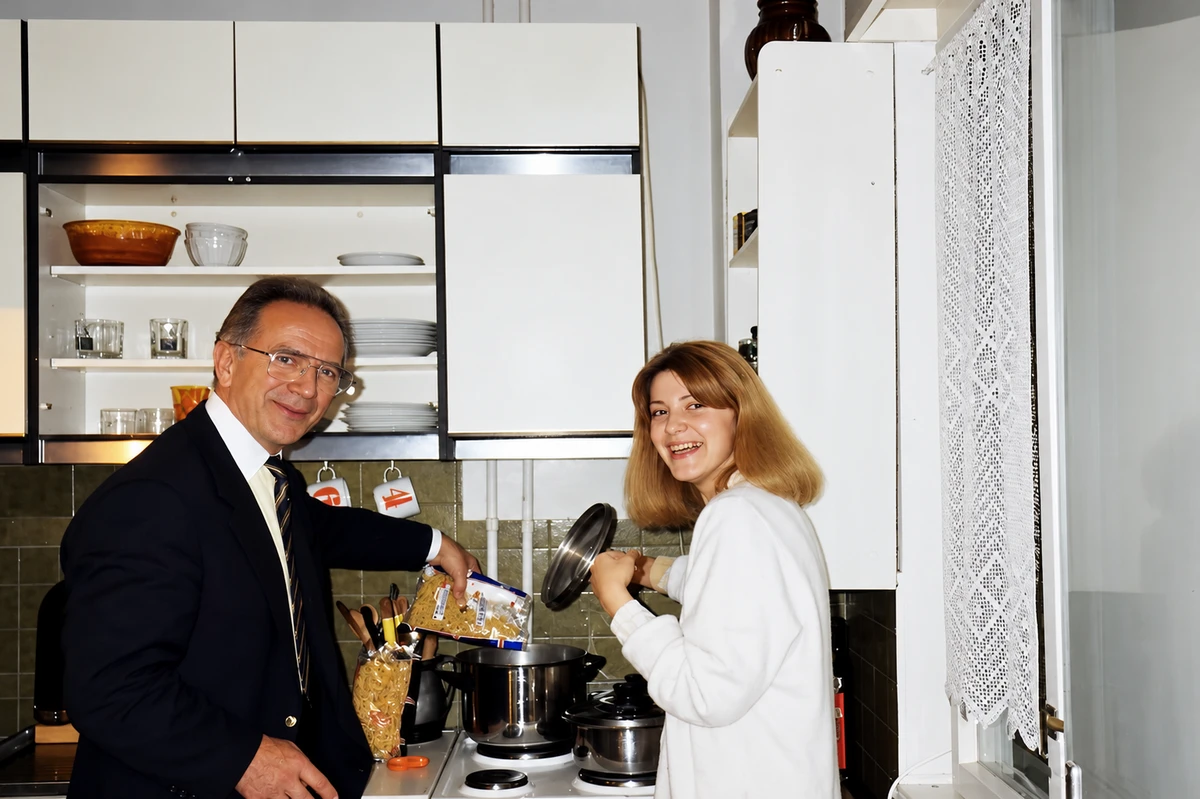
Milan Panić helped the author's wife in the kitchen (Source: private archive)
Everyone thought it was bizarre that he became prime minister. Even those who were actually happy about it. Panić found it less strange. He was starting to get used to all sorts of things happening in his life. By the way, I can still only guess today how he became prime minister (and how I became a minister). There was a rude Milošević majority in parliament.
I have heard the logical (but unproven) explanation several times that there was some kind of agreement between Milošević and the West, according to which Milošević (in order to avoid the punishment he deserved) would give way to a government of experts and organize early elections. It is very likely that something like this was really behind things.
This is how a businessman who had been living in California for almost forty years ended up as prime minister in Belgrade. He didn't really have any friends in Serbia. He was looking for friends, following advice and offers. Someone recommended me to him, and that's how our conversation took place.
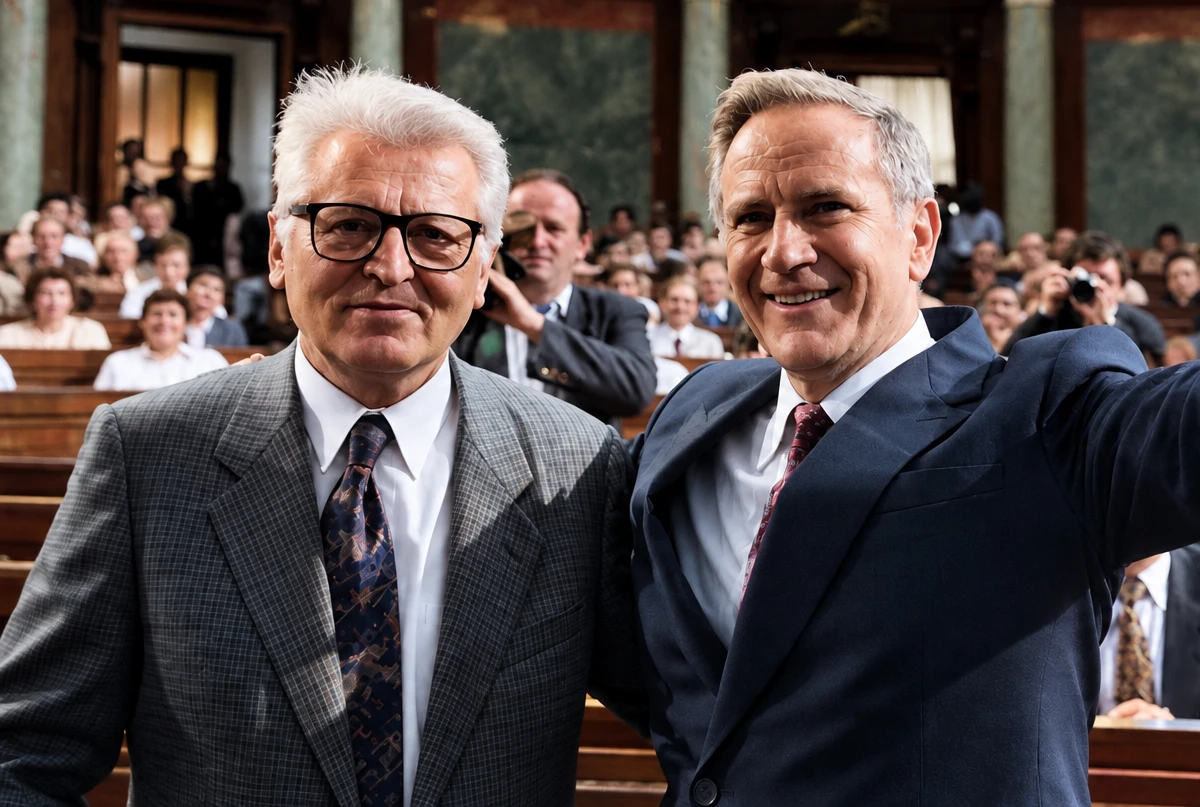
Milan Panić's short political career took place during the Yugoslav wars: in 1992, at the request of Dobrica Ćosić, also seen in the picture, he became prime minister, and later that year, as a presidential candidate, he advocated an end to the war and the end of international isolation, but lost to Slobodan Milošević.
Panić saw things as mostly clear and solvable. He also believed that we had to get out of the war and join the European Union. He believed that he would win the elections against Milošević. Also because they were on December 20th – his birthday. (Unfortunately, he didn't win.)
Before December 20th, we had a few more language-related experiences together. For example, when we went to visit Hungarian Prime Minister József Antall. The reception followed diplomatic rules exactly. The handshake was also formally friendly.
The Hungarian Prime Minister also organized a translation – of course, into the language of the visiting Prime Minister. That is why there was a translator – but one who would translate from Hungarian to Serbian. This did not bring a solution. I suggested that I step in as a translator, but József Antall thought it would be more appropriate to assign a professional English translator. We waited a little, but not long.
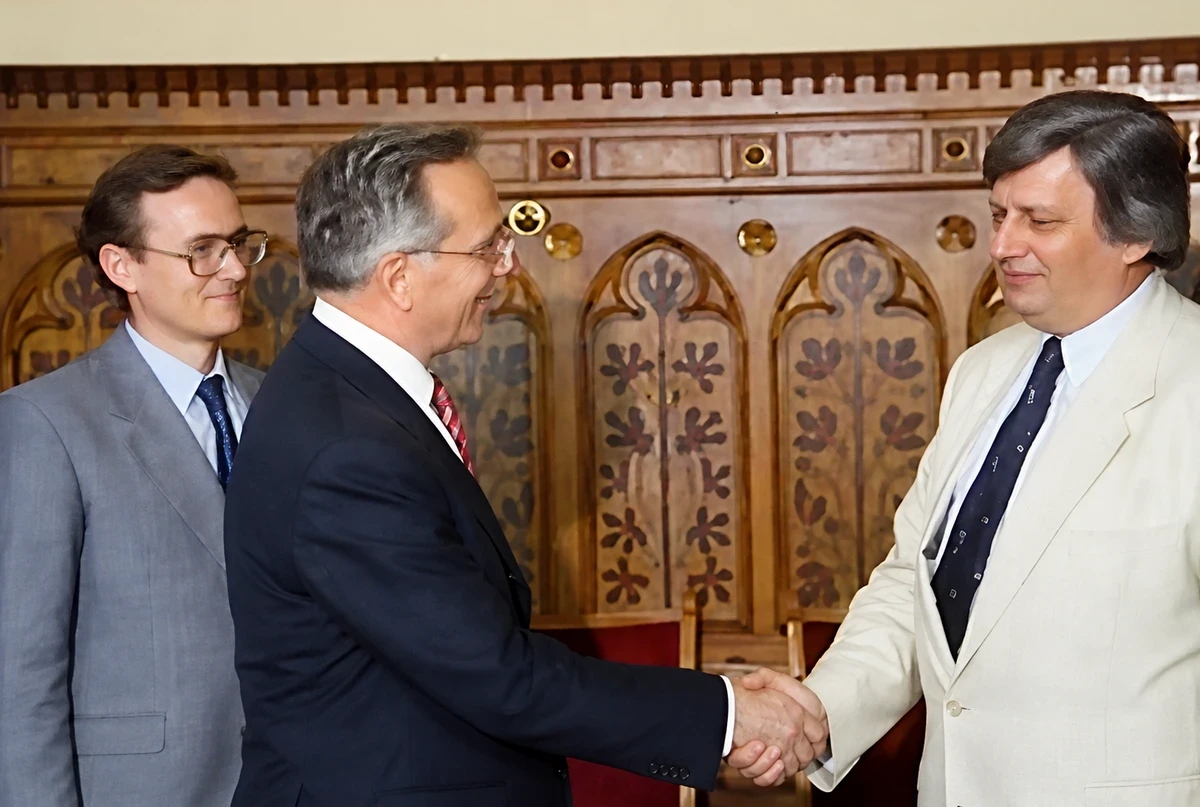
Meeting between József Antall and Milan Panic in Budapest, with Tibor Várady, then Minister of Justice, next to the Yugoslav Prime Minister (Archive)
I also remember that Panić's attachment to English helped in the area of minority rights. I drafted bills on minority language rights. Of course, these would only have had a chance if Panić won the elections on December 20. While drafting, it was appropriate to talk to the Prime Minister.
Panić had no objections to minority language rights. Mostly because he saw it as something temporary. He said: “Okay, let these, those and those languages be in official use, do as you like, it will all be temporary. Because soon everyone will be using English.”
And I also have a memory that it was not so much Serbian or English, but rather the business language that was crucial for him - and effective. We were in Geneva, at negotiations. Before us was an international initiative to exchange prisoners between the Serbian and Croatian sides in the war. Yugoslavia was an international subject (and negotiating party), but the real power belonged to the Serbian government.
My role was to draft a treaty on the exchange of prisoners. Of course, I did this with pleasure. Panić also supported it. But the prisoners were held by the Serbian authorities. One of Milošević's generals was also present in Geneva, he was vehemently opposed to the exchange. According to him, it would be unfair, because those who are held prisoner by the Croats are all true heroes, those who are prisoners in Serbia are all villains.
And here Panić's business language jumped in. He spoke in imperfect Serbian, but with great businesslike energy, explaining that the exchange would be very beneficial for us. In his words: "Pa to je odličan biznis! Oni nama daju odličan ljudi, mi njima dajemo škart!".
In Hungarian, this would sound like this: “But this is an excellent business! They give us excellent people, we give them bóvli!”. The prisoner exchange was established. Panić said many times, in several languages, that “it is possible!”. Sometimes he not only said it, but also showed it. We must not forget this either.
BALK Games
Choose a game and play right here on BALK!
Loading games…
The games are provided by GamePix. When you start the game, the content from the third-party provider is loaded.


Will Hungarians ever allow the Chinese high-speed rail?

Serbia gets away with Kushner deal without punishment

JANAF has a little hole, the Hungarian and Croatian Speakers met in Bratislava

The cronies are fleeing: after Veselinović, Radoičić has reportedly also resigned

Compulsory conscription: the University Student List wants volunteers, not conscripts

We ask for a beautiful smile! (but it can also be tearful) 🔞

God's mills grind slowly: After 35 years, the first compensation was awarded to a victim of Serbian concentration camps

Kurti would immediately make Serbian students answer: Recognition of Kosovo is the first lessonKurti is singing his own tune, already demanding recognition of Kosovo, which the winning University List had previously rejected

Croat-Bosnian (v)horrors: endless games in MostarMostar remains divided, conflict follows conflict 33 years after the destruction of Stari Most

Vučić is only a witness in the Šarić case for now - will he become a defendant?A drug lord's money laundering trial, did money from drug trafficking go to the Serbian Progressive Party?
God's mills grind slowly: After 35 years, the first compensation was awarded to a victim of Serbian concentration campsSerbian prison camps: must pay after 35 years, Belgrade fears for state coffers

Pásztor would bury the hatchet, Fremond would have coffee, Góli is looking for his hatThe campaigns are over, the VMSZ senior leadership does not want to see enemies, but cooperation with the Tündi-Bündi opposition

Fake 500 euro notes in the vault(?), real Russian depositors in pickleIt is not yet certain that there were any fake 500 euro notes, but it is certain that thousands of Russian depositors got into trouble.

Defense money: Romania would buy American soldiersBucharest is ready to pay the "transatlantic tribute", as long as the American soldiers stay


Sputnik: Hungary may pay dearly for giving up Russian energyMoscow is warning of price increases, and according to Sputnik, the Hungarian economy could also be affected.
The price of giving up Russian energy is already being calculated in Belgrade and Moscow. According to Sputnik Serbia, Hungary will face more expensive gas, uncertain oil supplies and...


Balázs Orbán defends Informer: he sees "authoritarian liberals" already in BelgradeBalázs Orbán defends Informer while Serbian media authority investigates channel's behavior
The Hungarian-Serbian political friendship persists even after the election defeats, and has now extended to saving Informer TV. Orbán...


THE BATTLE OF THE LOSERS: Vučić, Dodik and Pásztor friendship with OrbánAfter Orbán's visit to Belgrade, Vučić would once again take up the SNS presidency in a "sign of renewal"
Voters have rewritten the political map, but Viktor Orbán is still working from the old address list. On his Balkan tour, Milorad Dodik, Pásztor...


We ask for a beautiful smile! (but it can also be tearful) 🔞The grotesque world of the Kharkiv photography school, taboo-breaking artists and war images – also in Kragujevac
Ukrainian photography is not known for always showing the world as beautiful. From the grotesque images of the Kharkiv School to the fringes of society...


After the Moments of Fall (drama, with a happy-sad twist)Vučić announced defeat, then sang Rosemary. Arthur Miller's drama provides the encore and the impact
Aleksandar Vučić and the Serbian Progressive Party had a strange evening after the Serbian elections. The announcement of the defeat was met with stunned silence, then...


Books have their own problems too.The 69th Belgrade Book Fair has opened, but will soon close, and will be open for a week.
The 69th Belgrade Book Fair is still waiting for readers despite the boycott by several major Serbian publishers. This year's guest of honor is Tunisia, the...

Will Hungarians ever allow the Chinese high-speed rail?Belgrade-Budapest high-speed railway: the Chinese built it, but the Hungarians still won't let passengers on it
New flaws have been found in the security system of the Chinese high-speed railway, so the wait continues. The Budapest-Belgrade railway is scheduled to start passenger traffic this year...

Serbia gets away with Kushner deal without punishmentTrump's son-in-law will not have a luxury hotel in Belgrade, and the Serbian state can avoid a 50 million euro compensation claim
By terminating the Kushner contract, Serbia could not only get rid of Donald Trump's son-in-law's luxury hotel in Belgrade, but also face a compensation claim of up to 50 million euros...

JANAF has a little hole, the Hungarian and Croatian Speakers met in BratislavaDamage to JANAF's oil pipeline resulted in the release of 500 cubic meters, or half a million liters, of oil into the environment.
The damage to the JANAF oil pipeline in Croatia resulted in half a million liters of oil being released into the news, which at first glance sounds quite alarming. In cubic meters, this is only...

God's mills grind slowly: After 35 years, the first compensation was awarded to a victim of Serbian concentration campsSerbian prison camps: must pay after 35 years, Belgrade fears for state coffers
It took thirty-five years for a Serbian court to award compensation to a Croatian survivor of Serbian prison camps. The 1,5...

Croat-Bosnian (v)horrors: endless games in MostarMostar remains divided, conflict follows conflict 33 years after the destruction of Stari Most
Stari Most has been reconnecting the two banks of Mostar for more than twenty years, but the gap between the two communities continues to...


When Mercury intervenes in governanceThe Minister of Education of the Federation of Bosnia and Herzegovina blamed the problems on Mercury, then called the whole thing a social experiment
In Bosnia and Herzegovina, after political and economic difficulties, even celestial bodies are making governance difficult. Minister of Education and Science Jasna Duraković...


Proceedings against Montenegro over Pljevlja remain openSeventy million euros have already been spent, but the case has not been resolved, and the Pljevlja coal-fired power plant is a stumbling block on Montenegro's path to the EU.
Montenegro is already on the threshold of the European Union, but the chimney of the coal-fired power plant in Pljevlja continues to send smoke signals to Brussels. The seventy million euro...


Zagreb's semi-official message to Podgorica: don't count on German pressure to succeedZagreb's warning to Podgorica, Karlo Ressler's harsh words and the happy ending of a missing Bugatti
Thirty-three years have been wasted – at least according to the advisor to the Croatian Foreign Minister, this is how much bad politics has cost Montenegro. At the Zagreb roundtable...

Kurti would immediately make Serbian students answer: Recognition of Kosovo is the first lessonKurti is singing his own tune, already demanding recognition of Kosovo, which the winning University List had previously rejected
Serbian university students haven't even formed a government yet, and Albin Kurti would already be making them answer questions. Recognition of Kosovo would be the first exam question, Milan Radoičić...


Kosovo avoids new elections at the last minuteHe became president of Kosovo three minutes after midnight, but lawyers say the election may still be valid
Justina Shiroka-Pula became the new president of Kosovo with 81 votes, while the results of the vote were announced just three minutes after the constitutional deadline...


Fico would dismantle Slovakia's Western federal systemFico attacks the 2003 Slovak EU referendum without evidence, also opens a debate about NATO
Robert Fico would rewrite Slovakia's European history: he believes the results of the 2003 EU referendum were falsified, even though he himself voted for accession at the time...


The Hungarian Alliance in Slovakia is preparing for parliament, but was even pushed back in the local electionsThe Hungarian Alliance lost 326 seats, but is still preparing for parliament
In Slovakia, everyone declared themselves the winner after the local elections – at least according to the statements of the parties. However, in the case of the Hungarian Alliance, the...


The government trembled in Fico's handsAfter Taraba's fall, it was not just a ministerial position that was at risk, but Robert Fico's parliamentary majority.
After thirty-three years, the Slovak parliament has once again ousted a minister, but the departure of Tomáš Taraba is only the spectacular part of what is a serious...

Defense money: Romania would buy American soldiersBucharest is ready to pay the "transatlantic tribute", as long as the American soldiers stay
Allied loyalty has been raised to a new level in Bucharest: Romania would now not only host American soldiers, but would also pay for them to...


Full power government with a six-month warranty periodPSD received ministerial posts, PNL and RMDSZ support from outside: Luca Niculescu's government was voted in
The Romanian parliament voted for the government of Luca Niculescu, but no one gave a guarantee of political peace. The PSD won twelve ministerial seats...
