
Bosnia
Persona non grata: Bosnia expels two Serbian diplomatsBosnian Foreign Minister would break diplomatic relations with Serbia today, expects more than just words from the EU
Two Serbian diplomats have been declared persona non grata in Bosnia and Herzegovina, but Foreign Minister Elmedin Konaković would go much further: if it were up to him, he would break off diplomatic relations with Serbia right now. After the death of Ratko Mladić and his funeral in Belgrade, the political and memory policy conflict is now starting to develop into a classic diplomatic crisis – and thanks to the peculiarities of the Bosnian state structure, there is already a debate about whether Konaković could have sent back the person he sent home at all.


Diplomatic relations between Bosnia and Herzegovina and Serbia have also been affected by the political crisis surrounding the death of Ratko Mladić and his funeral in Belgrade. Bosnian Foreign Minister Elmedin Konaković expelled two Serbian diplomats who worked at Serbia's embassy in Sarajevo.
He declared them persona non grata and gave them 48 hours to leave Bosnia and Herzegovina. At the same time, he announced that he would recall a significant part of the staff of the embassy in Belgrade. However, the legality of these steps is already being questioned by Bosnian Serb leaders.
Persona non grata: two Serbian diplomats have 48 hours left
The Bosnian Foreign Minister announced that he had declared Milan Dulanović, the military attaché at the Serbian embassy in Bosnia and Herzegovina, and Danko Maksimović, an advisor to the representative of the Serbian Security Information Agency (BIA), persona non grata.
"Today I have made a decision to declare military attaché Milan Dulanović and Danko Maksimović persona non grata. They have forty-eight hours to leave Bosnia and Herzegovina," Konaković said.

The Foreign Minister referred to the regulations of the Bosnian Presidency adopted in 2004. The provision regulates the circumstances under which foreign diplomats and other employees of diplomatic missions can be declared persona non grata.
According to the regulations, the authority regarding heads of mission and consuls belongs to the presidency, while Konaković believes that the foreign minister can also act against other diplomatic and non-diplomatic employees of diplomatic missions. For example, he can send the cook home!
However, the two expulsions are only one element of the measures announced against Belgrade.
He would break off diplomatic relations with Serbia today
Konaković stated that he intends to minimize Bosnia and Herzegovina's diplomatic relations with Serbia.
As part of this, he wants to recall some of the employees of the Bosnian embassy in Belgrade, whom he is authorized to reassign as a minister.

The ambassador and consuls cannot be recalled, as their appointment and dismissal are decided by the three-member Presidency of Bosnia and Herzegovina.
"If I could, I would break off diplomatic relations with Serbia today. I will do everything I can to reduce relations to the lowest possible level," the foreign minister said.
According to Konaković, communication with the Serbian side will be reduced, recallable staff will be sent home, and some consular tasks will be transferred to Zagreb and Podgorica.
In practice, this could mean that Bosnian Ambassador Aleksandar Vranješ would remain in Belgrade with a much smaller staff.
The last alert was the Zvezda–Partizan match
Konaković clearly linked the diplomatic steps to the way the death and funeral of Ratko Mladić were handled in Serbia.
The former commander of the Bosnian Serb army was sentenced to life imprisonment by the international tribunal in The Hague for the Srebrenica genocide and other crimes against humanity and war crimes.

Serbian and Bosnian Serb political figures attended Monday's funeral in Belgrade and the commemorations that preceded it. However, the Bosnian foreign minister said the process had reached a point on Sunday evening where he had to react.
“The climax was last night's match against Crvena Zvezda with the message 'Direction Potočari'. That was the final warning signal,” said Konaković.
Before the 180th Belgrade match between Crvena Zvezda and Partizan, the two rival fan bases chanted Mladić's name together, followed by a minute of silence in the stadium. Zvezda's ultras also displayed Mladić's portrait and the inscription "Pravac Potočari" - "Towards Potočari" - on the stands.
The Srebrenica Genocide Memorial and Cemetery is located in Potočari.
Bosnia also expects a response from the European Union
According to Konaković, Sarajevo is also launching a diplomatic offensive. The Bosnian Foreign Ministry has prepared several draft letters and diplomatic notes.
The Foreign Minister would like to learn from the European Union, above all, how the EU institutions are reconciling what happened in Serbia with their own principles.
According to Konaković, the matter is no longer a historical memory policy debate, but in the case of Bosnia and Herzegovina, it is also a security policy issue.
He also indicated that he would be holding telephone talks with several foreign partners, which could result in diplomatic visits. They would also address the member states of the Organization of Islamic Cooperation with a separate letter.
Regarding Monday's statement by European Commission President Ursula von der Leyen, Konaković said that it improved the impression created by the previous EU reaction, but he believes that statements are no longer enough, concrete steps are needed.
The commission chairman noted in his post on X that Ratko Mladić was a convicted war criminal. He was responsible for genocide, war crimes, and crimes against humanity. He was serving a life sentence for the Srebrenica genocide and other crimes when he died.
Von der Leyen considered the elements of official support for the funeral and the presence of some high-ranking Serbian officials at the funeral to be deeply regrettable.
"These phenomena show that Serbia has failed to confront the dark chapter of Europe's recent past and contradict the values that underpin Serbia's path to the European Union," said the President of the European Commission. However, the question is whether he is just talking or doing something, as we have repeatedly experienced that it is not only Serbian President Aleksandar Vučić who cannot be taken seriously.

Will Ursula von der Leyen's love affair with Aleksandar Vučić continue? (Source: X platform)
For example, the European Union's Ursula could choose not to visit "dear Alexander" before the elections, meaning she could cancel her planned trip to Belgrade.
Željka Cvijanović: The military attaché should remain in Republika Srpska
The response was not long in coming. Željka Cvijanović, the Serb member of Bosnia and Herzegovina's tripartite presidency, disputed the legality of Konaković's actions.
According to Cvijanović, one of the Serbian embassy employees targeted for expulsion had already completed his term and left Bosnia and Herzegovina. He also claimed that in the case of military attaches, the necessary authority lies with the Bosnian Council of Ministers, not the Minister of Foreign Affairs.
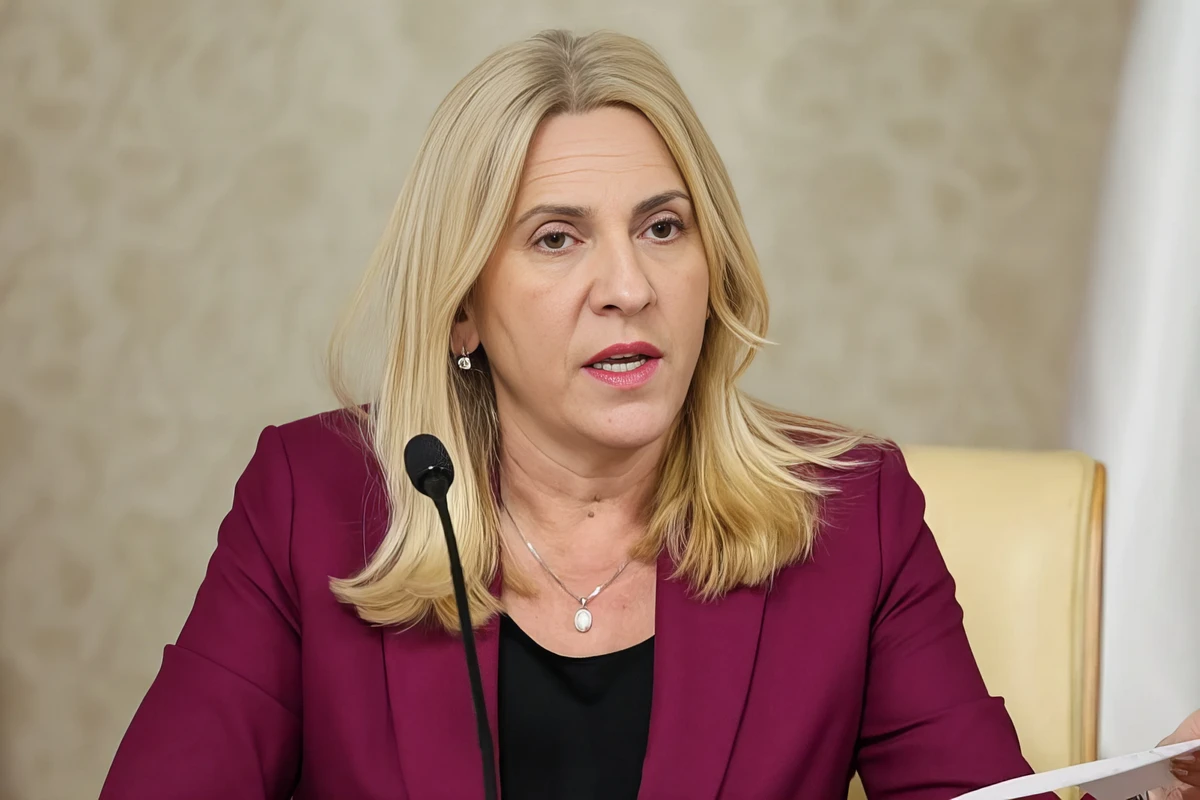
Željka Cvijanović, the Serbian member of the Presidency of Bosnia and Herzegovina, wants to request information from the competent institutions on whether the decision of the Minister of Foreign Affairs of Bosnia and Herzegovina, Elmedin Konaković, is well-founded (Source: klix.ba)
According to him, the revocation of a diplomat's right of residence must be supported by appropriate reasons and evidence.
Cvijanović therefore announced that he would request information from the competent institutions on whether the legal conditions for the decision made by Konaković exist.
He also called on the Serbian military attaché to remain in the territory of Republika Srpska, where, according to him, he would be provided with hospitality and protection.
This in itself shows the peculiar functioning of the Bosnian state structure: while the country's foreign minister calls on a Serbian diplomat to leave the entire territory of Bosnia and Herzegovina, a member of the state presidency essentially encourages the same person to remain in one of the country's entities.
Who has the right to declare a diplomat persona non grata?
At the heart of the legal dispute is a regulation adopted by the Bosnian presidency in 2004.
According to the provision cited by Klix, Bosnia and Herzegovina may declare a member of a foreign diplomatic or consular mission persona non grata if, among other things, he or she seriously violates the rules of the receiving state, engages in activities incompatible with his or her diplomatic duties, interferes in the country's internal affairs, engages in intelligence activities, or makes statements or acts that are offensive to the receiving state.
The Bosnian Foreign Minister and the Serbian member of the state presidency already have opposing positions on whether Konaković's specific decision meets these conditions and whether he has the necessary authority in both cases.
The ambassador says this is just electoral populism
Aleksandar Vranješ, Bosnia and Herzegovina's Serb ambassador to Belgrade, also challenged Konaković's announcement, saying the foreign minister had no right to simply dismiss all civil servants working at the embassy, as their legal status and mandate were protected by separate rules.

Aleksandar Vranješ arrived in Belgrade in 2023, where he met, among others, with the then Serbian Parliament Speaker Vladimir Orlić. The flag of Bosnia and Herzegovina was not displayed at the meeting, but instead the "inverted Russian" flag of the Republika Srpska was displayed (Source: Novosti)
Vranješ claimed that if Konaković were to issue a remand decision, those affected would be able to appeal and, according to him, they would have a good chance of proving that they were being used for political purposes.

The ambassador called the entire action electoral populism and claimed that Konaković was trying to score political points among Bosnian voters.
According to Vranješ, the announcement has already had a tangible consequence: on Monday morning, worried people visited the Belgrade representation because they feared that the consular department would be closed.
Vranješ has openly represented the political narrative of Republika Srpska in Belgrade, often echoing Dodik's position, something he learned well when he served as a political advisor in Milorad Dodik's cabinet between 2013 and 2018, so nothing surprising happened: national conflicts of interest are developing nicely in Bosnia and Herzegovina, as expected.
BALK Games
Choose a game and play right here on BALK!
Loading games…
The games are provided by GamePix. When you start the game, the content from the third-party provider is loaded.


Serbia gets away with Kushner deal without punishment

JANAF has a little hole, the Hungarian and Croatian Speakers met in Bratislava

The cronies are fleeing: after Veselinović, Radoičić has reportedly also resigned

Compulsory conscription: the University Student List wants volunteers, not conscripts

We ask for a beautiful smile! (but it can also be tearful) 🔞

God's mills grind slowly: After 35 years, the first compensation was awarded to a victim of Serbian concentration camps

Fake 500 euro notes in the vault(?), real Russian depositors in pickle

Kurti would immediately make Serbian students answer: Recognition of Kosovo is the first lessonKurti is singing his own tune, already demanding recognition of Kosovo, which the winning University List had previously rejected

Vučić is no longer president, but he would still dictate the paceThe new parliament hasn't even convened yet, but the destructive opposition is already trying to portray the election winners as incompetent.

Croat-Bosnian (v)horrors: endless games in MostarMostar remains divided, conflict follows conflict 33 years after the destruction of Stari Most

Vučić is only a witness in the Šarić case for now - will he become a defendant?A drug lord's money laundering trial, did money from drug trafficking go to the Serbian Progressive Party?
God's mills grind slowly: After 35 years, the first compensation was awarded to a victim of Serbian concentration campsSerbian prison camps: must pay after 35 years, Belgrade fears for state coffers

Pásztor would bury the hatchet, Fremond would have coffee, Góli is looking for his hatThe campaigns are over, the VMSZ senior leadership does not want to see enemies, but cooperation with the Tündi-Bündi opposition

Defense money: Romania would buy American soldiersBucharest is ready to pay the "transatlantic tribute", as long as the American soldiers stay


Sputnik: Hungary may pay dearly for giving up Russian energyMoscow is warning of price increases, and according to Sputnik, the Hungarian economy could also be affected.
The price of giving up Russian energy is already being calculated in Belgrade and Moscow. According to Sputnik Serbia, Hungary will face more expensive gas, uncertain oil supplies and...


Balázs Orbán defends Informer: he sees "authoritarian liberals" already in BelgradeBalázs Orbán defends Informer while Serbian media authority investigates channel's behavior
The Hungarian-Serbian political friendship persists even after the election defeats, and has now extended to saving Informer TV. Orbán...


THE BATTLE OF THE LOSERS: Vučić, Dodik and Pásztor friendship with OrbánAfter Orbán's visit to Belgrade, Vučić would once again take up the SNS presidency in a "sign of renewal"
Voters have rewritten the political map, but Viktor Orbán is still working from the old address list. On his Balkan tour, Milorad Dodik, Pásztor...


We ask for a beautiful smile! (but it can also be tearful) 🔞The grotesque world of the Kharkiv photography school, taboo-breaking artists and war images – also in Kragujevac
Ukrainian photography is not known for always showing the world as beautiful. From the grotesque images of the Kharkiv School to the fringes of society...


After the Moments of Fall (drama, with a happy-sad twist)Vučić announced defeat, then sang Rosemary. Arthur Miller's drama provides the encore and the impact
Aleksandar Vučić and the Serbian Progressive Party had a strange evening after the Serbian elections. The announcement of the defeat was met with stunned silence, then...


Books have their own problems too.The 69th Belgrade Book Fair has opened, but will soon close, and will be open for a week.
The 69th Belgrade Book Fair is still waiting for readers despite the boycott by several major Serbian publishers. This year's guest of honor is Tunisia, the...

Serbia gets away with Kushner deal without punishmentTrump's son-in-law will not have a luxury hotel in Belgrade, and the Serbian state can avoid a 50 million euro compensation claim
By terminating the Kushner contract, Serbia could not only get rid of Donald Trump's son-in-law's luxury hotel in Belgrade, but also face a compensation claim of up to 50 million euros...

The cronies are fleeing: after Veselinović, Radoičić has reportedly also resignedA former BIA inspector general's report has once again brought the Banjska attack and the Serbian political underworld in Kosovo to the fore
In Serbia, there has been a recent increase in urgent foreign trips among "businessmen" well-placed around the former government. Zvonko Veselinović has...

JANAF has a little hole, the Hungarian and Croatian Speakers met in BratislavaDamage to JANAF's oil pipeline resulted in the release of 500 cubic meters, or half a million liters, of oil into the environment.
The damage to the JANAF oil pipeline in Croatia resulted in half a million liters of oil being released into the news, which at first glance sounds quite alarming. In cubic meters, this is only...

God's mills grind slowly: After 35 years, the first compensation was awarded to a victim of Serbian concentration campsSerbian prison camps: must pay after 35 years, Belgrade fears for state coffers
It took thirty-five years for a Serbian court to award compensation to a Croatian survivor of Serbian prison camps. The 1,5...

Croat-Bosnian (v)horrors: endless games in MostarMostar remains divided, conflict follows conflict 33 years after the destruction of Stari Most
Stari Most has been reconnecting the two banks of Mostar for more than twenty years, but the gap between the two communities continues to...


When Mercury intervenes in governanceThe Minister of Education of the Federation of Bosnia and Herzegovina blamed the problems on Mercury, then called the whole thing a social experiment
In Bosnia and Herzegovina, after political and economic difficulties, even celestial bodies are making governance difficult. Minister of Education and Science Jasna Duraković...


Proceedings against Montenegro over Pljevlja remain openSeventy million euros have already been spent, but the case has not been resolved, and the Pljevlja coal-fired power plant is a stumbling block on Montenegro's path to the EU.
Montenegro is already on the threshold of the European Union, but the chimney of the coal-fired power plant in Pljevlja continues to send smoke signals to Brussels. The seventy million euro...


Zagreb's semi-official message to Podgorica: don't count on German pressure to succeedZagreb's warning to Podgorica, Karlo Ressler's harsh words and the happy ending of a missing Bugatti
Thirty-three years have been wasted – at least according to the advisor to the Croatian Foreign Minister, this is how much bad politics has cost Montenegro. At the Zagreb roundtable...

Kurti would immediately make Serbian students answer: Recognition of Kosovo is the first lessonKurti is singing his own tune, already demanding recognition of Kosovo, which the winning University List had previously rejected
Serbian university students haven't even formed a government yet, and Albin Kurti would already be making them answer questions. Recognition of Kosovo would be the first exam question, Milan Radoičić...


Kosovo avoids new elections at the last minuteHe became president of Kosovo three minutes after midnight, but lawyers say the election may still be valid
Justina Shiroka-Pula became the new president of Kosovo with 81 votes, while the results of the vote were announced just three minutes after the constitutional deadline...


Fico would dismantle Slovakia's Western federal systemFico attacks the 2003 Slovak EU referendum without evidence, also opens a debate about NATO
Robert Fico would rewrite Slovakia's European history: he believes the results of the 2003 EU referendum were falsified, even though he himself voted for accession at the time...


The Hungarian Alliance in Slovakia is preparing for parliament, but was even pushed back in the local electionsThe Hungarian Alliance lost 326 seats, but is still preparing for parliament
In Slovakia, everyone declared themselves the winner after the local elections – at least according to the statements of the parties. However, in the case of the Hungarian Alliance, the...


The government trembled in Fico's handsAfter Taraba's fall, it was not just a ministerial position that was at risk, but Robert Fico's parliamentary majority.
After thirty-three years, the Slovak parliament has once again ousted a minister, but the departure of Tomáš Taraba is only the spectacular part of what is a serious...

Defense money: Romania would buy American soldiersBucharest is ready to pay the "transatlantic tribute", as long as the American soldiers stay
Allied loyalty has been raised to a new level in Bucharest: Romania would now not only host American soldiers, but would also pay for them to...


Full power government with a six-month warranty periodPSD received ministerial posts, PNL and RMDSZ support from outside: Luca Niculescu's government was voted in
The Romanian parliament voted for the government of Luca Niculescu, but no one gave a guarantee of political peace. The PSD won twelve ministerial seats...
