
Serbia
Ratko Mladić was buried with church and military honors, with state figures in attendanceThe Novi Sad representative of the Vojvodina Hungarian Association also paid tribute to Ratko Mladić, while in Belgrade the war criminal was buried with military honors
The VMSZ has also become part of the hero cult that is once again developing around Ratko Mladić. While the former Bosnian Serb commander convicted of genocide and war crimes was buried with military honors in Belgrade, Gyula Kiss, a VMSZ representative in Novi Sad, also voted to pay tribute to Mladić in the city council.

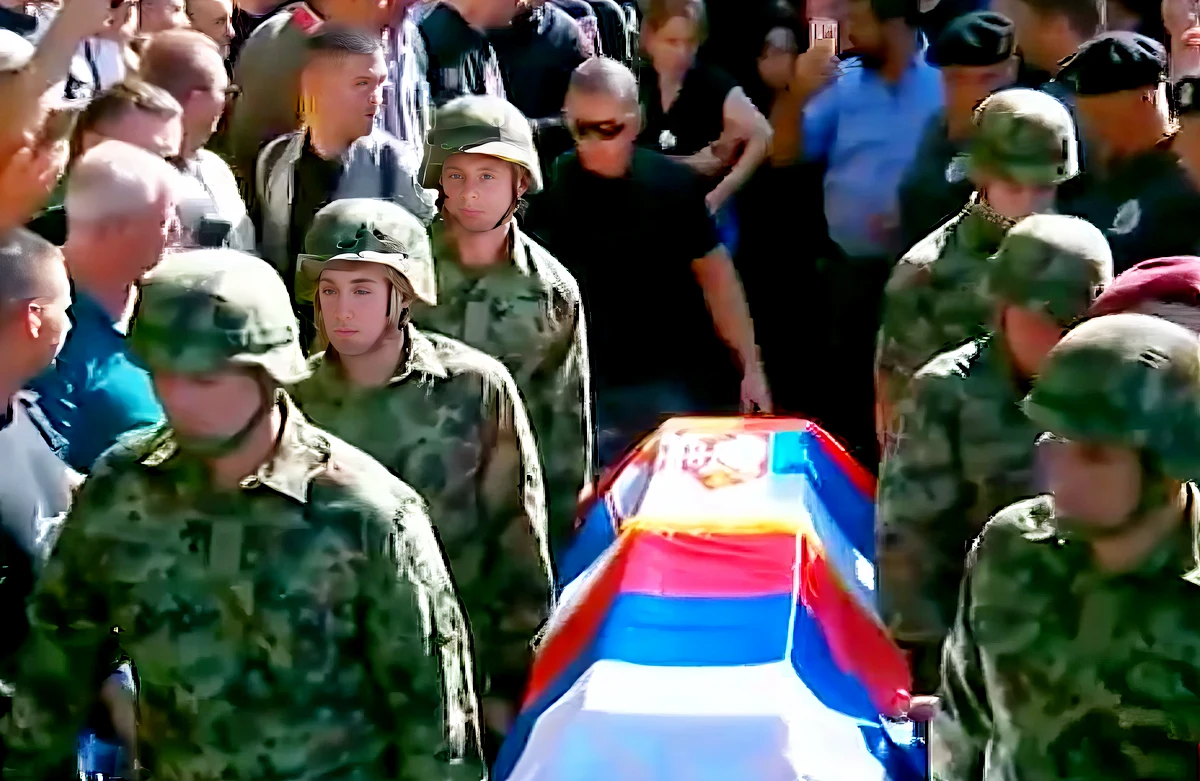

The VMSZ also became part of the hero cult that is once again developing around Ratko Mladić: the former Bosnian Serb army commander, sentenced to life imprisonment for genocide and war crimes, was buried in Belgrade with military honors.
According to Serbian Patriarch Porfirije, Mladić's name will be remembered with gratitude by the majority of the Serbian Orthodox people, and his son said: his father saved an entire people, but his enemies fabricated lies about him.
Ratko Mladić buried in Belgrade
Ratko Mladić, the former commander of the Army of the Republika Srpska, who died in The Hague, where he was serving a life sentence for genocide, crimes against humanity and war crimes, was laid to rest at the Topčideri Cemetery in Belgrade.

The Russian ambassador to Belgrade, Aleksandr Botsan-Kharchenko, also appeared at the coffin of the Bosnian military commander who was laid to rest, and is seen in the picture with the widowed Bosijlka Mladić (Source: Screenshot)
The farewell ceremony went far beyond a family funeral. The coffin was laid to rest with military honors, members of the Serbian Army fired ceremonial shots, a military band played, and the crowd bid farewell to Mladić with the tune of "Tamo daleko".
Citing security sources close to the government, Informer, which is often prone to exaggeration, claimed that a total of more than 150 people visited the Church of St. Luke and the wider area of the Topčider cemetery during the day.
Other reports spoke of thousands of participants and did not indulge in exaggerated estimates, but one thing is certain: there were many people at the funeral, too many to believe in democratic changes in Serbia.
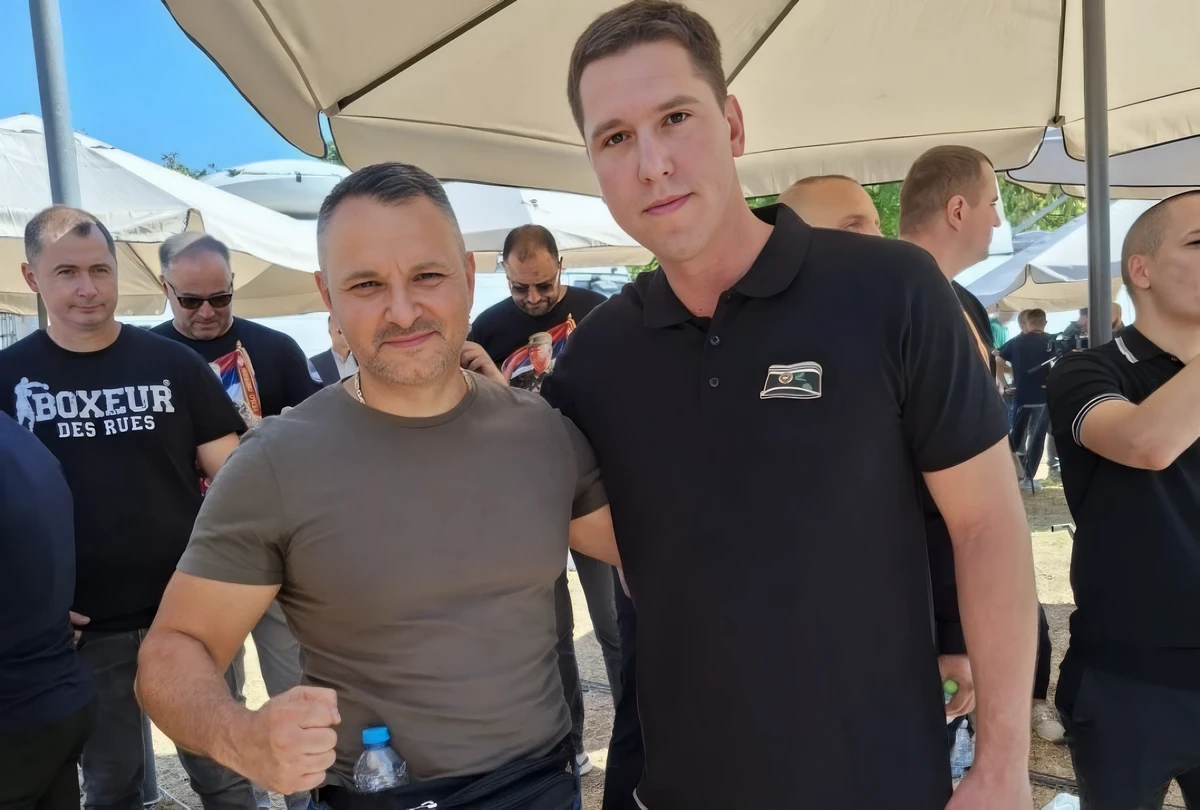
The funeral was also attended by Serbian President Aleksandar Vučić's son, Danilo Vučić, who is pictured on the right (Source: Informer)
The funeral was attended by high-ranking political and public figures. Several Serbian ministers and the son of Serbian President Aleksandar Vučić, Danilo Vučić, who is sometimes seen in the company of the Partizan Belgrade hardliners, as well as several ministers of the Serbian government, were also present. The funeral was attended by Bosnian Serb leader Milorad Dodik, who arrived in Belgrade at the head of a large Bosnian Serb political delegation.
In the church, the Russian ambassador to Belgrade, Alexander Botsan-Kharchenko, also paid his respects to the former Bosnian Serb military commander, who could hardly have done so without Moscow's approval or express instructions.
Porfirije: Mladić's name will be remembered with gratitude by the majority of the Serbian people
The funeral service was led by Serbian Patriarch Porfirije in the Church of St. Luke, with the participation of several bishops of the Serbian Orthodox Church.
In his speech, the patriarch simultaneously referred to all the victims of the Yugoslav wars and questioned the finality of earthly justice.

Patriarch Porfirije ignored the earthly court ruling, and the Serbian head of the church said that God will correct what the Hague Tribunal ruled.
As he said, "no earthly court is infallible," and no single judgment can fully exhaust the truth about a person's life. According to him, the final and perfectly just judgment belongs only to God, which suggests that the Serbian Patriarch therefore entrusted it to God to set things right.

With this statement, the Serbian church leader descended to the level of Crvena Zvezda fans, or turned the fans into church people, as in January 2023, the hard core of the Serbian club's fans occupied the historic bridge over the Drina in Višegrad.
While lighting torches imitating the Serbian, Bosnian Serb and Russian national colors, members of the fan group unfurled banners on the bridge, one of which read "The hand of God is stronger than the court" (Božija ruka jača od suda!).
According to the patriarch, "the name of General Ratko Mladić is deeply etched in the memory and prayers of the majority of the Serbian people," because many see him as a soldier and commander who led the army of his people in a tragic era, and who bore a heavy responsibility and burden, made sacrifices, and gave his life "for the freedom, protection, and survival of his people."
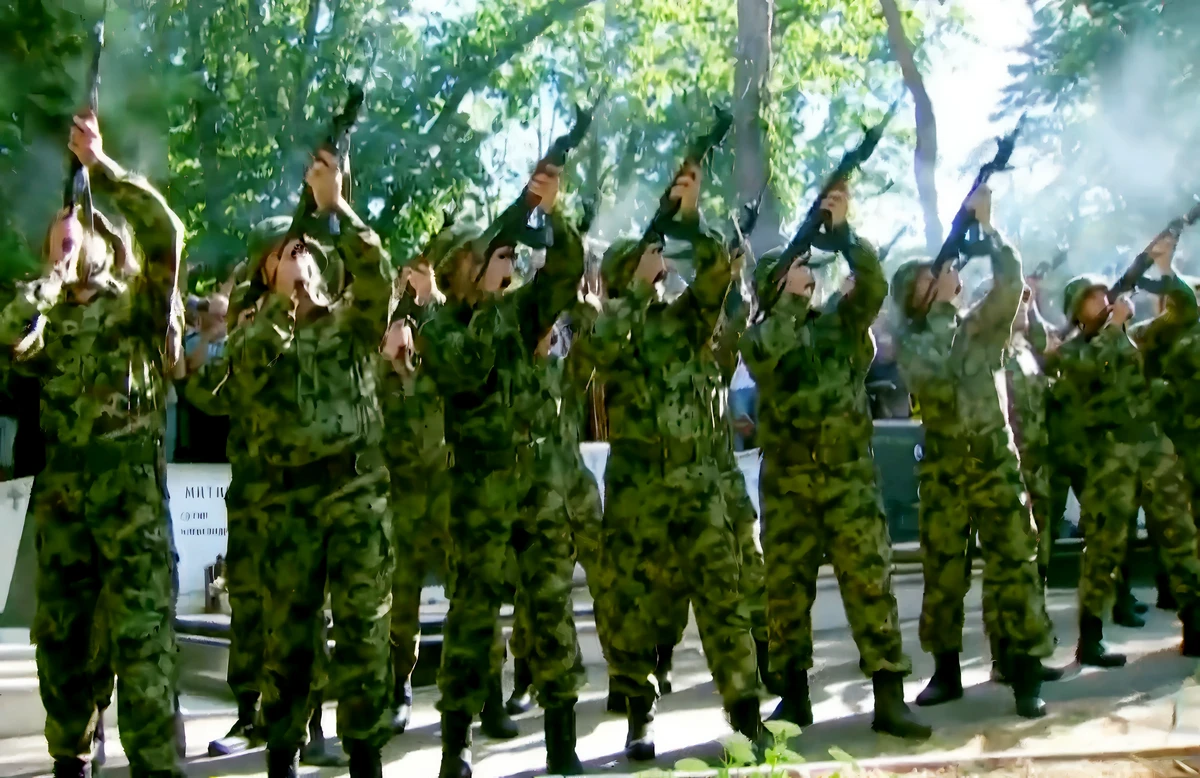
It's only natural that there would be a ceremonial firework at the funeral of a (former) military officer.
The patriarch also spoke about how Mladić was a Christian, confessed and received communion in his final years, and died with a cross on his chest. He added that the church does not pass final judgment on anyone, but prays for God's mercy.
But in the case of Ratko Mladić, there is also an earthly sentence. It is not a political label, not a journalistic qualification, and not the narrative of some Balkan nation, but a final international court verdict: Mladić was sentenced to life imprisonment for, among other things, the Srebrenica genocide and other war crimes.
“Hero or criminal?” – “Hero!”
While Porfirije used the language of religion to put the verdict of the earthly court in a different light, Mladić's son spoke without any nuances.
Darko Mladić told those present that he was not giving a traditional eulogy, but was addressing his father, and the crowd could overhear this "conversation".
He recalled his father's life and military career, then declared: "You saved the people."
Darko Mladić says his father's enemies first tried to buy and intimidate him, and then, when that failed, they began to fabricate "lies" about him. He portrayed the Hague justice system as an artificially created court whose task, he said, was to turn defenders into criminals and traitors into heroes.
Then he turned to the crowd:
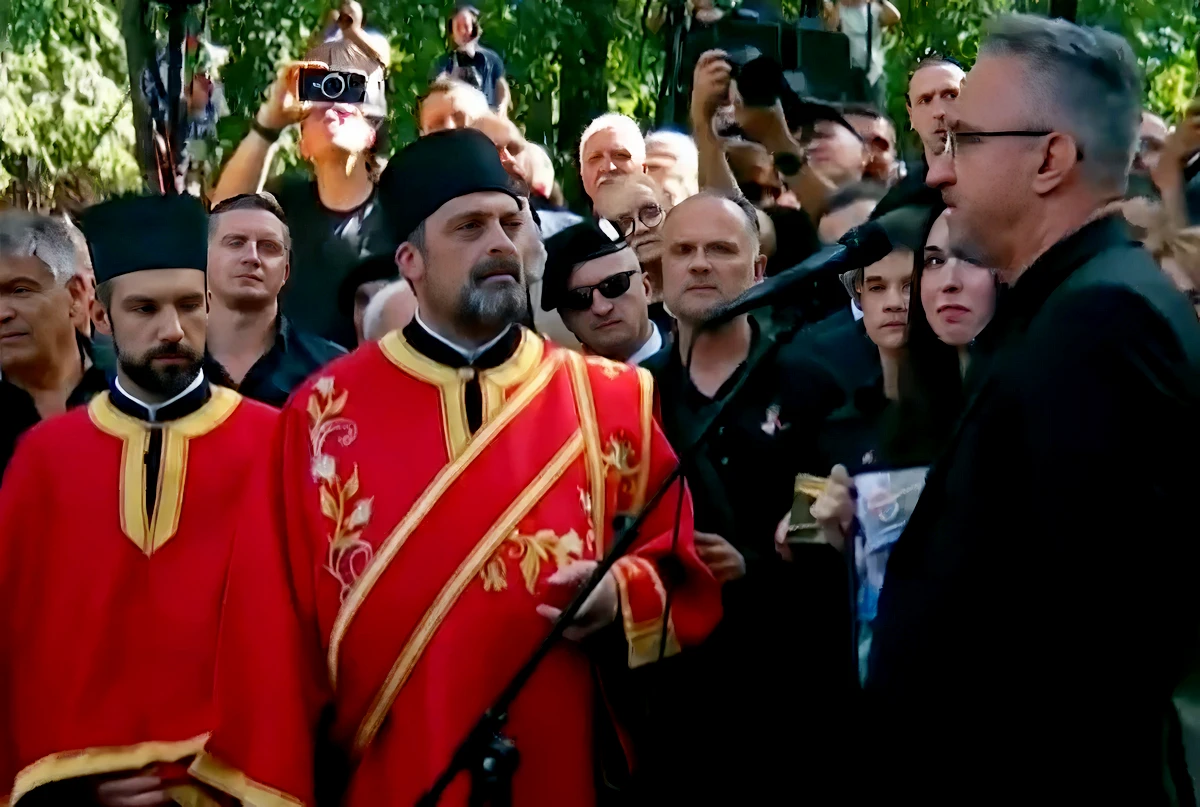
The former general's son conducted a quick poll of those present about his father's opinion (Screenshot)
"Thank you, brothers, for coming to decide whether my father was a hero or a criminal."
The response was a mass chant:
"Hero! Hero! Hero!"
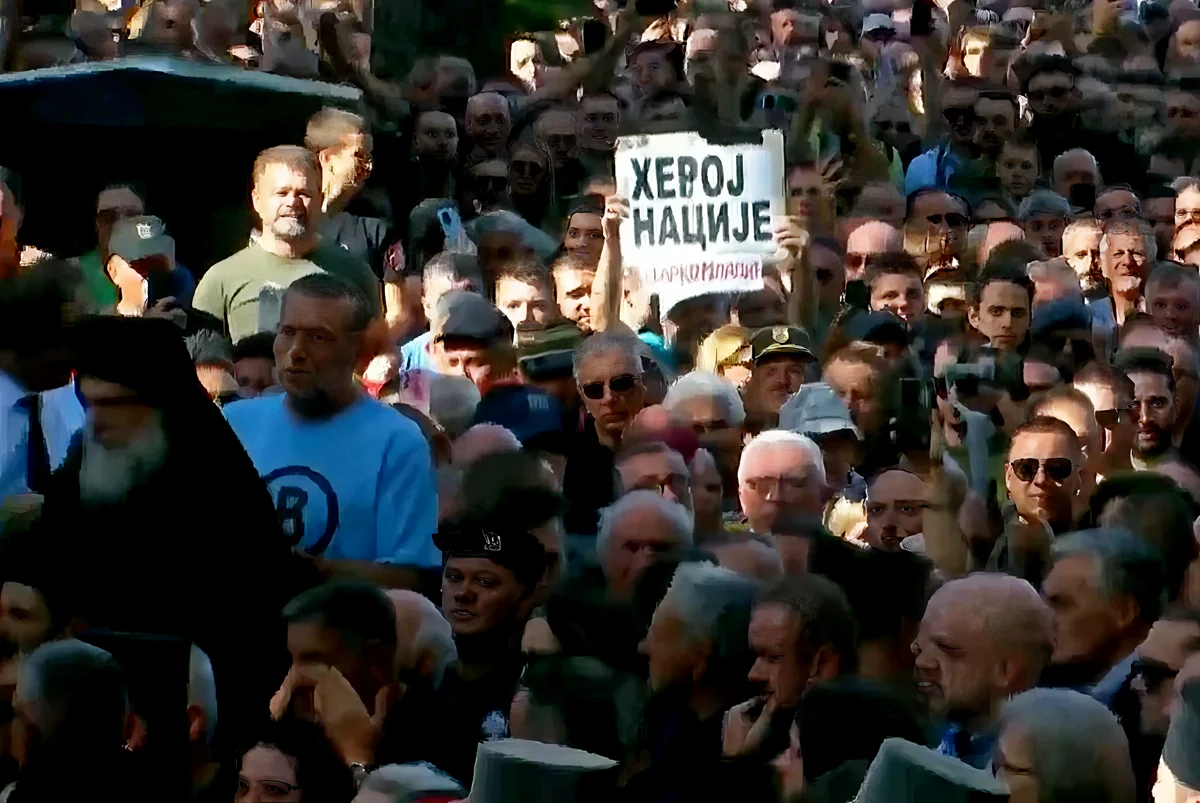
Among the participants in the funeral were those who not only chanted, but also "visually demonstrated" that they considered Ratko Mladić a hero, a national hero at that (Source: Screenshot)
Darko Mladić claimed that his father was “killed by the enemy in The Hague,” and then said goodbye to him:
"Travel, father, travel, commander. All that remains for us is to be proud of you."
In Novi Sad, the VMSZ also voted to pay tribute to Ratko Mladić
It is also important to record all this because the cult of Ratko Mladić did not remain in Belgrade on that day, nor did it remain within the Serbian people.
At the beginning of the Novi Sad city council session, Nedeljko Klisurić, a representative of the Serbian Progressive Party, initiated the council to pay tribute to the memory of Ratko Mladić.

The proposal was supported by 46 representatives of the majority. Among them were representatives of the Serbian Progressive Party, the Socialist Party of Serbia, the Movement of Socialists and the Serbian Radical Party. And among them was the only representative of the Vojvodina Hungarian Association, Gyula Kiss.
This is worth mentioning separately: the representative of the VMSZ voted together with the representatives of the Serbian Radical Party to have the Novi Sad assembly pay tribute to Ratko Mladić, who was finally convicted of genocide and war crimes, while the opposition representatives left the meeting room.
The Novi Sad city council is certainly not the forum where the fate of the Hungarians in Vojvodina is decided. It is not where the future of Hungarian-language education, the full enforcement of minority rights, or the survival of the Hungarian community in Vojvodina is decided.
The Hungarian representation performance of the VMSZ should not be judged solely on the basis of a single vote at the general assembly in Novi Sad. But there are cases in which even a single vote constitutes a serious political position.
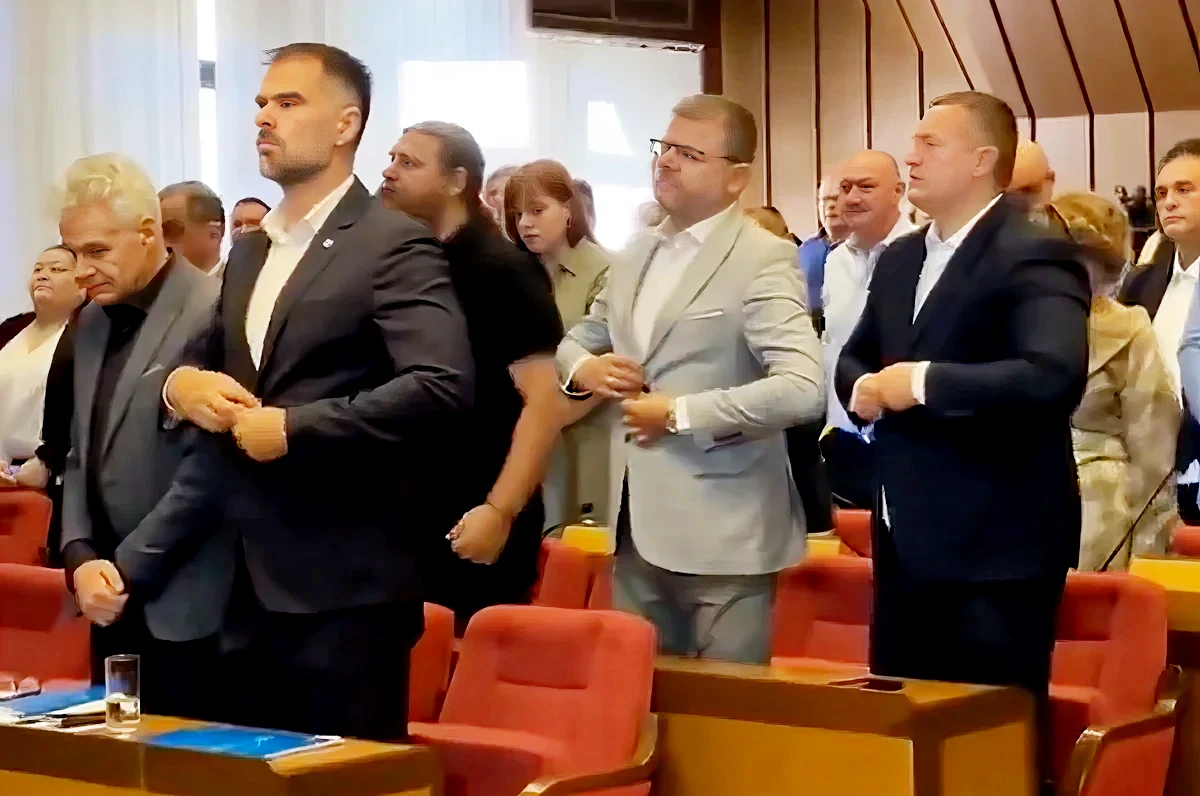
Those who remained behind closed doors observed a period of silence (Source: 021)
It is hardly an excessive expectation for a Hungarian interest-based party not to support the political cult of a convicted war criminal. This does not require being in the opposition, not terminating any coalition, and not even taking a position on issues of Serbian national memory.
There is simply no need to vote. Especially not together with the Serbian Radical Party.
Broadcasting was turned off in Bosnia
The political conflict surrounding Mladić's funeral was also broadcast on television screens in Bosnia and Herzegovina.

BH Telecom interrupted the transmission of the Bosnian Serb public television, RTRS, and Alternativna televizija (ATV), which is close to Milorad Dodik, on its cable platform because they broadcast a special program about Mladić's funeral.
BH Telecom – according to its own statement, citing its obligations under Bosnian law – interrupted the transmission of RTRS and ATV during the special program on Mladić's funeral. Later, Telemach did the same. According to Klix, the signal of the anti-Dodik but equally nationalist BN television station also disappeared.

Dear users! In accordance with the current legislation of Bosnia and Herzegovina, we are interrupting the broadcast of the program for the duration of the broadcast of the content about the funeral of Ratko Mladić. Ratko Mladić was finally sentenced to life imprisonment by the International Criminal Tribunal for the former Yugoslavia for genocide, crimes against humanity, and violations of the laws and customs of war. Such content may directly or indirectly glorify convicted war criminals, and may also offend the public interest and the feelings of the victims. Thank you for your understanding!
The pro-government Serbian Informer called this a “scandal” and interpreted it as a restriction on media freedom and the viewers’ right to information. In Serbia, “viewers’ rights” were not restricted, as Informer continuously broadcast the funeral and boasted that the whole of Serbia was watching them.
Of course, there can and should be debates about media freedom and the circumstances under which a service provider can interrupt the transmission of a television program. However, it is difficult to argue that Ratko Mladić's funeral was much more than a farewell to a dead soldier.
It became a political event, during which a finally convicted war criminal was once again transformed into a hero, with a very small amount of assistance from the Hungarian Military Academy.
BALK Games
Choose a game and play right here on BALK!
Loading games…
The games are provided by GamePix. When you start the game, the content from the third-party provider is loaded.


Will Hungarians ever allow the Chinese high-speed rail?

Serbia gets away with Kushner deal without punishment

JANAF has a little hole, the Hungarian and Croatian Speakers met in Bratislava

The cronies are fleeing: after Veselinović, Radoičić has reportedly also resigned

Compulsory conscription: the University Student List wants volunteers, not conscripts

We ask for a beautiful smile! (but it can also be tearful) 🔞

God's mills grind slowly: After 35 years, the first compensation was awarded to a victim of Serbian concentration camps

Kurti would immediately make Serbian students answer: Recognition of Kosovo is the first lessonKurti is singing his own tune, already demanding recognition of Kosovo, which the winning University List had previously rejected

Croat-Bosnian (v)horrors: endless games in MostarMostar remains divided, conflict follows conflict 33 years after the destruction of Stari Most

Vučić is only a witness in the Šarić case for now - will he become a defendant?A drug lord's money laundering trial, did money from drug trafficking go to the Serbian Progressive Party?
God's mills grind slowly: After 35 years, the first compensation was awarded to a victim of Serbian concentration campsSerbian prison camps: must pay after 35 years, Belgrade fears for state coffers

Pásztor would bury the hatchet, Fremond would have coffee, Góli is looking for his hatThe campaigns are over, the VMSZ senior leadership does not want to see enemies, but cooperation with the Tündi-Bündi opposition

Fake 500 euro notes in the vault(?), real Russian depositors in pickleIt is not yet certain that there were any fake 500 euro notes, but it is certain that thousands of Russian depositors got into trouble.

Defense money: Romania would buy American soldiersBucharest is ready to pay the "transatlantic tribute", as long as the American soldiers stay


Sputnik: Hungary may pay dearly for giving up Russian energyMoscow is warning of price increases, and according to Sputnik, the Hungarian economy could also be affected.
The price of giving up Russian energy is already being calculated in Belgrade and Moscow. According to Sputnik Serbia, Hungary will face more expensive gas, uncertain oil supplies and...


Balázs Orbán defends Informer: he sees "authoritarian liberals" already in BelgradeBalázs Orbán defends Informer while Serbian media authority investigates channel's behavior
The Hungarian-Serbian political friendship persists even after the election defeats, and has now extended to saving Informer TV. Orbán...


THE BATTLE OF THE LOSERS: Vučić, Dodik and Pásztor friendship with OrbánAfter Orbán's visit to Belgrade, Vučić would once again take up the SNS presidency in a "sign of renewal"
Voters have rewritten the political map, but Viktor Orbán is still working from the old address list. On his Balkan tour, Milorad Dodik, Pásztor...


We ask for a beautiful smile! (but it can also be tearful) 🔞The grotesque world of the Kharkiv photography school, taboo-breaking artists and war images – also in Kragujevac
Ukrainian photography is not known for always showing the world as beautiful. From the grotesque images of the Kharkiv School to the fringes of society...


After the Moments of Fall (drama, with a happy-sad twist)Vučić announced defeat, then sang Rosemary. Arthur Miller's drama provides the encore and the impact
Aleksandar Vučić and the Serbian Progressive Party had a strange evening after the Serbian elections. The announcement of the defeat was met with stunned silence, then...


Books have their own problems too.The 69th Belgrade Book Fair has opened, but will soon close, and will be open for a week.
The 69th Belgrade Book Fair is still waiting for readers despite the boycott by several major Serbian publishers. This year's guest of honor is Tunisia, the...

Will Hungarians ever allow the Chinese high-speed rail?Belgrade-Budapest high-speed railway: the Chinese built it, but the Hungarians still won't let passengers on it
New flaws have been found in the security system of the Chinese high-speed railway, so the wait continues. The Budapest-Belgrade railway is scheduled to start passenger traffic this year...

Serbia gets away with Kushner deal without punishmentTrump's son-in-law will not have a luxury hotel in Belgrade, and the Serbian state can avoid a 50 million euro compensation claim
By terminating the Kushner contract, Serbia could not only get rid of Donald Trump's son-in-law's luxury hotel in Belgrade, but also face a compensation claim of up to 50 million euros...

JANAF has a little hole, the Hungarian and Croatian Speakers met in BratislavaDamage to JANAF's oil pipeline resulted in the release of 500 cubic meters, or half a million liters, of oil into the environment.
The damage to the JANAF oil pipeline in Croatia resulted in half a million liters of oil being released into the news, which at first glance sounds quite alarming. In cubic meters, this is only...

God's mills grind slowly: After 35 years, the first compensation was awarded to a victim of Serbian concentration campsSerbian prison camps: must pay after 35 years, Belgrade fears for state coffers
It took thirty-five years for a Serbian court to award compensation to a Croatian survivor of Serbian prison camps. The 1,5...

Croat-Bosnian (v)horrors: endless games in MostarMostar remains divided, conflict follows conflict 33 years after the destruction of Stari Most
Stari Most has been reconnecting the two banks of Mostar for more than twenty years, but the gap between the two communities continues to...


When Mercury intervenes in governanceThe Minister of Education of the Federation of Bosnia and Herzegovina blamed the problems on Mercury, then called the whole thing a social experiment
In Bosnia and Herzegovina, after political and economic difficulties, even celestial bodies are making governance difficult. Minister of Education and Science Jasna Duraković...


Proceedings against Montenegro over Pljevlja remain openSeventy million euros have already been spent, but the case has not been resolved, and the Pljevlja coal-fired power plant is a stumbling block on Montenegro's path to the EU.
Montenegro is already on the threshold of the European Union, but the chimney of the coal-fired power plant in Pljevlja continues to send smoke signals to Brussels. The seventy million euro...


Zagreb's semi-official message to Podgorica: don't count on German pressure to succeedZagreb's warning to Podgorica, Karlo Ressler's harsh words and the happy ending of a missing Bugatti
Thirty-three years have been wasted – at least according to the advisor to the Croatian Foreign Minister, this is how much bad politics has cost Montenegro. At the Zagreb roundtable...

Kurti would immediately make Serbian students answer: Recognition of Kosovo is the first lessonKurti is singing his own tune, already demanding recognition of Kosovo, which the winning University List had previously rejected
Serbian university students haven't even formed a government yet, and Albin Kurti would already be making them answer questions. Recognition of Kosovo would be the first exam question, Milan Radoičić...


Kosovo avoids new elections at the last minuteHe became president of Kosovo three minutes after midnight, but lawyers say the election may still be valid
Justina Shiroka-Pula became the new president of Kosovo with 81 votes, while the results of the vote were announced just three minutes after the constitutional deadline...


Fico would dismantle Slovakia's Western federal systemFico attacks the 2003 Slovak EU referendum without evidence, also opens a debate about NATO
Robert Fico would rewrite Slovakia's European history: he believes the results of the 2003 EU referendum were falsified, even though he himself voted for accession at the time...


The Hungarian Alliance in Slovakia is preparing for parliament, but was even pushed back in the local electionsThe Hungarian Alliance lost 326 seats, but is still preparing for parliament
In Slovakia, everyone declared themselves the winner after the local elections – at least according to the statements of the parties. However, in the case of the Hungarian Alliance, the...


The government trembled in Fico's handsAfter Taraba's fall, it was not just a ministerial position that was at risk, but Robert Fico's parliamentary majority.
After thirty-three years, the Slovak parliament has once again ousted a minister, but the departure of Tomáš Taraba is only the spectacular part of what is a serious...

Defense money: Romania would buy American soldiersBucharest is ready to pay the "transatlantic tribute", as long as the American soldiers stay
Allied loyalty has been raised to a new level in Bucharest: Romania would now not only host American soldiers, but would also pay for them to...


Full power government with a six-month warranty periodPSD received ministerial posts, PNL and RMDSZ support from outside: Luca Niculescu's government was voted in
The Romanian parliament voted for the government of Luca Niculescu, but no one gave a guarantee of political peace. The PSD won twelve ministerial seats...
